
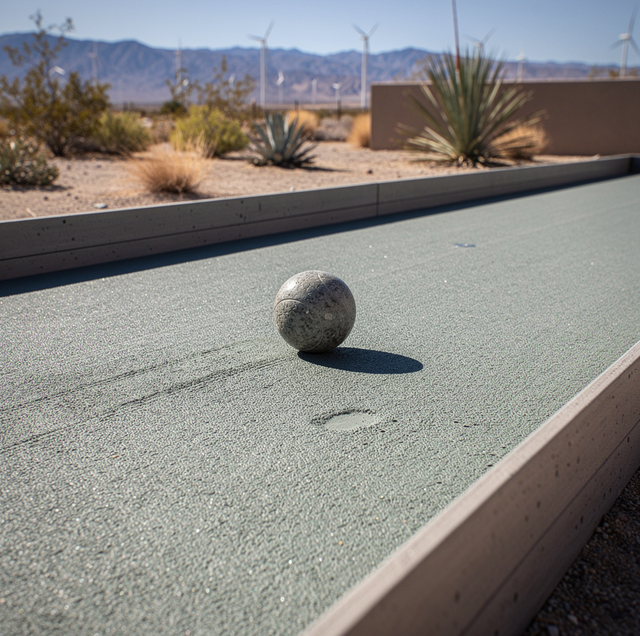
A bocce surface has to let a heavy ball roll true and come to rest exactly where it was thrown, hold a flat plane from one end of the lane to the other, and play the same way this season as it did last season. An acrylic-coated slab and a synthetic turf lane both aim at that same job, but they get there through different mechanisms. The acrylic court relies on a hard, flat coated slab and the fine texture built into that coating; the turf lane relies on the fiber, the infill packed between the blades, and the compacted base under both of them. Comparing the two only makes sense once that difference is out in the open, and that difference decides how each surface plays, drains, and ages.
Ball roll, flatness, drainage, surface heat, upkeep, and repairs each play out differently once you set an acrylic slab against a turf lane point for point:
| Factor | Acrylic | Synthetic Turf |
|---|---|---|
| Ball roll and speed | Fast, true roll off a hard, textured slab | Slower, gripped roll through fiber and infill |
| A thrown or lofted ball landing | Lands hard and can skid or bounce before it settles | Lands softer and settles close to where it lands |
| Flatness and what holds it | The coated slab itself carries the plane | A compacted stone base or a concrete slab under the turf carries the plane |
| Drainage after rain or irrigation | Sheds water off the coating to the lane's edges | Drains through the backing into the base or across the slab beneath |
| Surface heat on a sunny afternoon | A dark or sun-exposed coating can get hot enough to burn bare skin | Fiber and dark infill can get hot enough to burn bare skin |
| Upkeep between seasons | Cleaning and periodic recoating restore color and texture | Brushing the fiber upright and topping up infill keeps it true |
| Repairs | A cracked or peeling patch is cut back and recoated | A worn or torn section is cut out and patched in |
How the Ball Rolls and Stops on Each Surface
The same fine texture that keeps a player's shoe from slipping on an acrylic court is also what determines how a bocce ball behaves once it leaves your hand, because the ball rides across thousands of small high points in the coating rather than a glass-smooth plane. The hardness of the slab keeps a well-rolled ball on its line and carrying its speed, and the texture sets how much friction slows it before it stops.
Turf works on the opposite principle. A ball crossing turf has to push through standing fiber and settle a little into the give of the infill beneath it, and that resistance bleeds off speed steadily along the entire roll rather than in a sudden drop at the very end. A well-thrown shot stops closer to where it lands than the same throw would on acrylic. A misjudged shot that would skid wide on a hard slab instead slows and stops closer to the turf, which changes how forgiving a lane feels to a player still learning distance and touch.
A lofted or bounced shot shows the same split. On acrylic, a ball that lands hard can skid or take a secondary bounce before it finally settles because there is little to absorb the initial impact. On turf, the fiber and infill cushion the landing, so a lofted ball settles close to where it first touches down instead of carrying on. Each behavior is simply what that surface does with the energy of the throw.
Flatness, the Base and Why a Lane Plays Level End to End
A bocce ball is heavy and unforgiving of a lane that is not level, so flatness is not a cosmetic detail on either surface. On acrylic, the coated slab itself is the rigid plane the ball travels across, and that slab sits on a compacted base built to carry it without settling unevenly over time. On turf laid over compacted stone, there is no rigid slab doing that work, so the base carries the plane on its own; any low spot or soft area in it telegraphs up into the playing surface, while turf laid over a concrete base takes its plane from the slab.
A curb or frame along the edge of either surface keeps the base material and the infill contained at the border, which is one more reason the lane's edges are worth checking along with the field of play itself: a border or backboard that sits proud of the surrounding ground is also a trip hazard at either end of the lane.
Drainage and Water After Rain or Irrigation
An acrylic slab sheds water off the coating toward the lane's edges on a pitch kept as slight as drainage allows, so water does not collect in the middle of play. A wet acrylic surface is also slicker underfoot than a dry one, so play on an acrylic lane pauses until the water has sheeted off and the coating has dried.
Turf handles water differently. Instead of sheeting across a hard plane, rain or irrigation water drains down through the turf backing and into the granular base beneath, the same base that holds the lane flat. A turf lane that drains well returns to normal play once that base has taken the water; one that drains poorly can stay soft and slow after the rain has stopped, which traces to the base and the backing.
Surface Heat and Barefoot or Seated Play
The same rule that governs court color and surface heat in general applies to a bocce lane, too: a darker finish, whether it is the acrylic coating or the infill packed into the turf, absorbs more of the sun's energy than a lighter one and runs hotter to the touch on either surface.
Bocce has its own version of that heat question because of the way the game is played. Players stand close to the lane for long stretches of a match, and a bocce layout can include chairs, a bench, or a low wall right along the edge, where people sit for the whole game rather than moving across the entire surface the way a larger court sport does. So a hot afternoon surface reaches past the players stepping onto it, to anyone sitting close enough to rest a bare foot, a hand or a pet's paws against it.
A sun-heated acrylic slab or dark turf infill can burn bare feet, a seated player's skin, or a pet's paws, so barefoot play waits until the surface has cooled; the turf and infill color are chosen with the court builder during design.
Keeping Each Surface Playing True
Acrylic upkeep centers on cleaning and, eventually, recoating. The coating's fine texture wears smoother with every rolling ball and every footstep across it, so a lane that has gone quiet and glassy in the high-traffic middle is due for a fresh coat rather than another cleaning.
Turf upkeep is a different set of tasks. Brushing the fiber upright after it gets matted down by rolling and foot traffic, topping up infill where it has thinned, and clearing leaves and other debris from the fiber all help keep a turf lane playing the way it did when it was new. Infill that migrates off the lane and onto a nearby walkway or patio can turn those surfaces slick underfoot too, so brushing displaced infill back onto the turf is part of routine upkeep.
Repairs follow the same split. A cracked or peeling patch of acrylic coating is cut back to sound material and recoated to blend with the surrounding surface. A worn or torn section of turf is cut out, and a matching patch is fitted and seamed in, working with the backing rather than the coating.
Choosing a Surface by How the Court Gets Used
A casual backyard lane that sees an occasional game after dinner asks less of a surface than a lane built for a club-style game played weekend after weekend, or a lane that has to double as part of a larger multi-sport pad. A lane built to share space with a bigger multi-sport court leans toward whichever surface that primary sport already uses, since matching materials avoids an awkward seam where two different systems meet.
Decomposed granite, crushed stone, and other natural lane materials are a third path, with their own feel and their own upkeep, and they are worth weighing alongside acrylic and turf. Which of the three fits a given yard comes down to how frequently the lane gets used, what else shares the space, and how much upkeep a household wants to take on.
Frequently Asked Questions
It can, but the seam between the two systems needs its own detailing. Where an acrylic edge meets a turf edge, the transition is framed so the coating does not chip at that joint and the turf does not fray or lift where it meets the harder surface.
Yes, more than in other games that share the same base. Because a bocce throw travels the length of the lane in one continuous roll rather than in short back-and-forth exchanges, a low spot or an off-plane section pulls the ball off its line for the whole distance it keeps rolling, so a flatness problem that a shorter court sport can hide shows up clearly on a bocce lane.
On turf, a ball's momentum is already dropping steadily from the fiber and infill before it ever reaches the backboard, so contact there is lighter. On acrylic, a ball that has held its speed across the lane can strike the backboard with real force, which is why the backboard and its padding matter more on an acrylic-surfaced lane than on a turf one.
It depends on the direction. Converting from acrylic to turf can keep the slab: the turf is laid over it, with a pad in some builds, and water runs off across the slab's own pitch instead of down into a stone base. Going from turf to acrylic requires a rigid slab first, since an acrylic coating requires a hard, bonded surface and cannot be applied over compacted stone.
No. On acrylic, the foul and midcourt lines are painted onto the coating and are renewed when the lane is recoated. On turf, lines are either strips of a contrasting fiber seamed into the lane or painted onto the fiber, and seamed-in lines stay in place through brushing and infill top-ups.
Turf muffles the sound of the ball, both rolling across the lane and striking the backboard, more than acrylic does. On an acrylic lane, a resin ball rolling across the coating and striking the end frame produces a clearer, more noticeable sound, which is worth considering when a lane is close to a house, a patio, or a shared property line.
Commission bocce court construction — a post-tensioned concrete or compacted stone base, drainage, border edging, and the lane surface settled at the design consultation. CourtMaster Sports, Inc. serves the Coachella Valley and Las Vegas. Call (760) 548-3545 in Palm Springs or (702) 825-8818 in Las Vegas.