
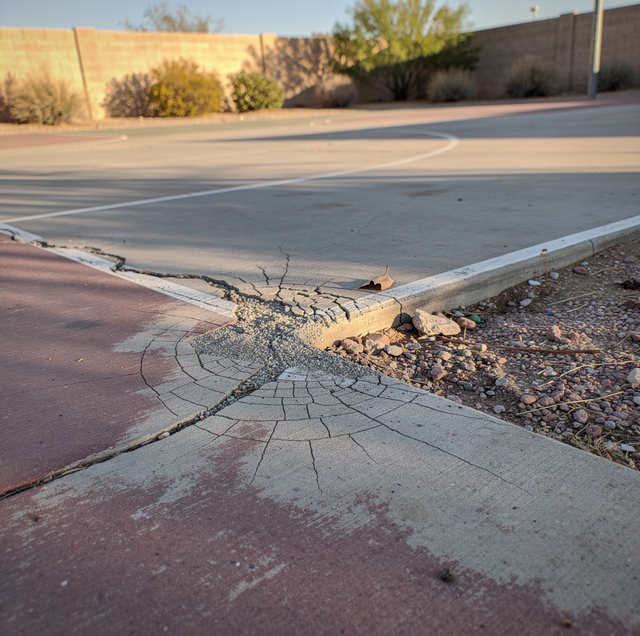
The color on your court has gone from a clean forest green to something closer to gray, and a spider of hairline lines is running out from one corner. Tearing the whole thing out and starting over sounds like the safe move, but a full rebuild is a lot of court to lose if the asphalt underneath still has service left. The condition of the asphalt mat underneath determines it.
Acrylic resurfacing doesn't replace what's below it. It's laid down in thin coats directly on top of whatever asphalt is already there, which means every failure already working inside that old pavement becomes part of the new surface's foundation whether anyone planned for it to or not. Asphalt has its own way of aging that a concrete court never deals with, and that's what decides whether a fresh coat holds or a rebuild is the better call.
Old Asphalt Still Has to Carry the New Surface
Asphalt is a mat of aggregate held together by a bitumen binder, not a single rigid slab the way concrete is. That binder is what gives an asphalt court its flex, and it's also what ages: sun and heat dry the oils out of it over the years, and the mat gets stiffer and more brittle the older it gets.
A mat that has gone stiff also splits in long straight lines or blocks when it expands and contracts with temperature. On a court that swings wide between hot and cold hours, those lines open and close further each day than on one where temperatures hold steadier, so a crack that looks tight on a cool morning is measured in the afternoon before anyone decides a resurface can bridge it.
A new acrylic system laid over that mat is thin, built to flex a little and carry color and texture, not to double as a second structural layer, so the mat underneath still has to do the job it always did: carry the load, resist water, and hold its shape. Resurfacing is a bet that the mat can keep doing that job, and that the binder underneath the color settles the bet.
Oxidized Binder and Raveling: What a Resurface Can Seal
As that binder oxidizes, it loses its grip on the stone it's supposed to hold, and the first visible sign is usually raveling: loose aggregate working free at the surface, often starting at the edges or in the heaviest traffic lanes, where you can feel loose stone underfoot or find it collecting wherever the court drains.
A patch of light, isolated raveling doesn't call for anything drastic. Once the crew cleans out the loose material and patches it solid, a resurface seals over that spot without complaint. Raveling that's spread across a wide section, with loose aggregate coming up over a broad area rather than a few isolated patches, is a different signal: it means the binder has failed at a mat-wide scale rather than in one weak spot, and cleaning and patching that much surface only buys a season before the same stone works loose again. A resurface can live with raveling that's confined and freshly patched. It cannot live with a binder that's failing across the whole mat.
Alligator Cracking: The Mat's Own Fatigue Sign
A web of interconnected cracks resembling the surface of dried, cracked mud, sometimes called alligator cracking, is the asphalt mat's own fatigue sign rather than a single working line. It means the mat is bending under load more than it can survive, usually because the base or subgrade under that area has lost support, often to water, or the mat was too thin for what sits and moves on it.
Coat over alligatored asphalt and the same flex telegraphs straight back through the new acrylic, and the pattern returns in the new color, because the movement that caused it was never addressed. An isolated, quiet line that stays put is one thing a resurface handles without trouble. A mat that's alligatored and fatigued across a wide area is not.
Cure Time and Bond Prep Before the Acrylic Goes Down
Old, oxidized asphalt has to be cleaned down to a sound surface before anything bonds to it: loose stone, dust, and any asphalt-based sealer or oil spots come off first because acrylic does not grip them. The first coat applied over it is a sand-filled acrylic resurfacer, which fills the open texture of the aged mat and provides a uniform base for the color coats.
Repairing a failed spot starts with cutting it out cleanly, not just filling over it. The crew saw-cuts a straight edge around the damaged section, since a ragged, feathered edge won't compact evenly, excavates down to sound base material, tacks that cut edge so the new asphalt bonds to the old rather than sitting against it, and compacts the fresh hot mix while it's still hot with a plate compactor or a small roller.
Fresh patch material carries its own timeline, separate from the surrounding old asphalt. A hot-mix patch needs time to cool and finish curing before it's ready for a coating system, and rushing that process traps oils still migrating out of the new material beneath the acrylic film, which can leave a patch that never fully bonds or softens later in the heat.
The Edge Is Asphalt's Weakest Point
An asphalt court's edges are its weakest point structurally, because the pavement thins out and loses confinement right where it meets bare ground, landscaping, or a fence line. Water finds that seam before it finds anywhere else, wicking in from the perimeter and softening the base right under the edge long before the middle of the court shows any sign of trouble. An edge that's crumbling, or dips toward the boundary instead of staying level with the rest of the surface, is usually one that's been taking on water for years.
A resurface with sound edge repair, recompacting, and patching that perimeter strip before coating can hold up fine on a court whose drainage still carries water away from the edge. It won't hold on a court where grading nearby has shifted enough to funnel water back against a failing edge, because the coating goes down on top of a problem that's still being fed.
A Core Sample Tells You What a Walk-Around Can't
None of these signs are read reliably from a single spot on the surface. Before committing to either path, a contractor pulls a core sample, a small cylindrical plug drilled straight through the mat, at a few points across the court. The core shows how much sound asphalt thickness remains beneath any raveled or oxidized skin, and whether moisture has worked its way in and begun stripping the binder from the aggregate, where it can't be seen from above. A court that looks marginal on the surface can core out solid, and one that looks fine on top can core out already stripped underneath, which is why a contractor pulling cores before quoting the job is worth more than one who just walks the court.
Frequently Asked Questions
A stiff broom run over the area is a rough field gauge: how much stone comes free indicates how much of the section needs patching before coating.
Only where bare asphalt is what the coating is going over, a court getting its first-ever coating, or a fresh asphalt patch inside an older court. There, dark asphalt can telegraph faintly through a light topcoat if too few coats go down, an issue a lighter concrete base doesn't create the same way. On a court that's simply being recoated over its existing color, the old acrylic is already the base color, so switching to a different color doesn't require an extra coat.
Yes. Where the mat is sound but uneven or widely raveled, a new asphalt overlay can go over it, and the new acrylic system then goes on only once that overlay has cured, as with a fresh patch. Around fences, curbs, and net-post footings, the added thickness must be planned so that the edges still shed water.
Asphalt's flexibility makes it prone to rutting, shallow depressions under sustained heavy, stationary loads such as bleacher feet or a weighted portable net base left in one spot through a hot season, a failure a concrete base does not show. Moving those loads around between seasons spreads the wear.
Any loose aggregate left in a raveled area works its way up through the coats as they're applied, creating a slightly raised or gritty spot that telegraphs through the top color coat and doesn't sand down evenly. That's why a raveled section gets vacuumed or blown clean, not just swept, before the acrylic system starts going on.
Coating manufacturers generally call for new asphalt, including a hot-mix patch, to cure for at least 14 days before acrylic is applied, and some specify up to 30 days. A court with several patches is scheduled around the newest one, not the oldest.
Have your old asphalt evaluated before it's recoated — a walkthrough that sorts which failures a resurface can handle from those that call for a rebuild. CourtMaster Sports, Inc. serves the Coachella Valley and Las Vegas. Call (760) 548-3545 in Palm Springs or (702) 825-8818 in Las Vegas.