
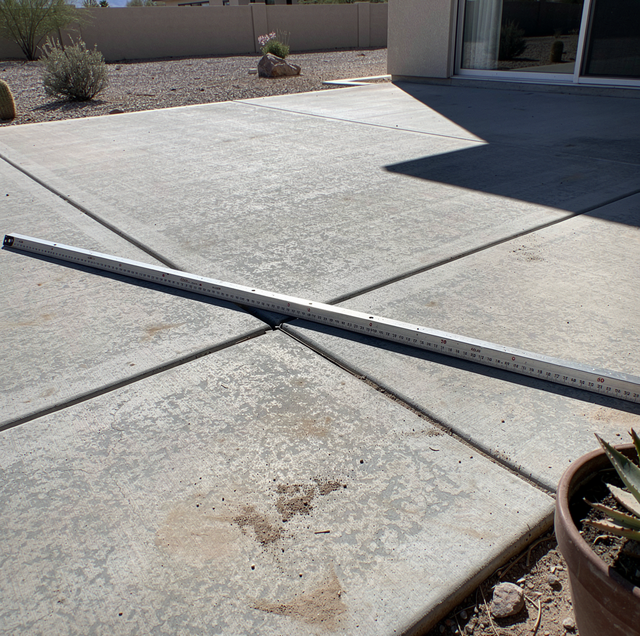
A patio slab that is already poured looks like the fast way onto a pickleball court: skip the excavation, skip the concrete truck, and put a coating system straight on what is already there. Whether that shortcut works is a structural question, and it comes down to how the existing slab measures up against what a court needs: its size, flatness, cracks and joints, thickness and base, and drainage. The checklist below runs through each of those checks, and the sections after it walk through what each one changes.
| Check | What It Means | What to Do |
|---|---|---|
| Slab size vs. playing and run-off area | The patio has to hold the court rectangle plus safe run-off on every side, not just the painted lines | Measure the full footprint against the patio's real edges, corner to corner |
| Flatness and slope | A slab that dips or crowns changes ball bounce and lets water collect | Check the surface with a straightedge or a taut string line across several directions |
| Cracks and control joints | Existing cracks and joints can telegraph straight through a new coating | Map every crack and joint before deciding on a repair or a bridging system |
| Thickness and base | A slab built for foot traffic may be thinner or reinforced differently than a court base | Confirm the slab's thickness and reinforcement before committing to a conversion |
| Drainage | Standing water breaks a coating down and turns a smooth surface slick | Confirm the slab sheds water in one direction rather than into low spots |
| Surface system on top | The existing finish decides whether a new coating will bond at all | Decide on prep, grinding, patching, or a bridging membrane, before coating goes down |
What the Slab Has to Measure
The playing rectangle and its run-off follow the same footprint any pickleball court needs. What matters for an existing patio is comparing that footprint against what is poured: a rectangle that reads fine on a tape measure can come up short once an uneven edge, a planter bed, or a slab that was never poured square gets accounted for. Run-off that ends at a wall, a step, a planter, or patio furniture is where a player chasing a wide ball hits something solid. Walk the patio's real corners and its real edges before assuming the shape underneath it fits, rather than trusting the number written on an old permit or a builder's drawing.
A coated slab turns slick when wet, and a lunge on it can end in a fall into whatever borders the patio. Keep play off a wet court and have the installer lay out the runoff clear of walls, steps, and furniture.
Flatness, Planarity, and the Puddle Test
A patio poured for foot traffic, and furniture is held to a different flatness standard than a slab meant to carry a fast-moving ball at a low, consistent bounce. A dip that nobody notices while carrying a plate outside becomes a spot where the ball dies early or kicks sideways once play starts on it. Run a straightedge or a taut string line across the surface in several directions and watch for light showing underneath: a level slab holds the straightedge tight from end to end, while a slab that has settled or crowned shows a gap in the middle or at an edge. After rain, or a hose test if rain will not cooperate, watch where water collects rather than where the slab looks flat to the eye. Standing water shows a low spot a straightedge can miss.
How Existing Cracks and Control Joints Reflect Through a Coating
A coating system is thin and follows the shape of whatever lies beneath it rather than hiding it. A patio's control joints were cut to guide shrinkage cracking along a predictable line while the concrete cured, and a joint that does that is a design feature, not damage. A crack that opens elsewhere on the slab, especially one that keeps widening, is a different animal, and both kinds telegraph through a new coating in their own way if they are painted over.
Wide swings between a hot afternoon and a cool night push a slab through real expansion and contraction. That repeated movement is one of the forces, with settlement and soil movement, that widens a hairline crack enough to show through a coating. A slab that sits through steadier temperatures experiences less daily cycling stress, so its joints and cracks tend to stay quieter over the same stretch of years. Where the slab cycles through wide daily swings, treat a crack that has widened as active and bridge it or rebuild that section; where temperatures hold steady, a hairline crack that has not moved can be routed and filled. Either way, map where every joint and crack is located before the court layout is drawn on top of it.
Crack-Bridging or Membrane Systems
Where a crack is still active rather than settled, a bridging or membrane system placed under the color coats is the option a builder weighs before writing a section of slab off entirely, and how that kind of repair behaves is the same regardless of whether the base started life as a patio. What is specific to a patio is that its joints were spaced for the slab's own shrinkage, not for a court layout, so some of them will fall inside the playing lines.
Drainage Slope
A patio is built to carry rain away from the house, sloped toward the yard or a drain near its edge. A court needs that same shedding engineered as one deliberate plane across the entire surface, a slope close to a one percent grade, so water moves to a single edge or corner instead of pooling at center court or along a baseline. Confirm the patio's existing pitch runs the right direction and covers the whole slab as a single plane. A patio poured in sections, each draining toward its own low point near a door or a step, will pond once it is a pickleball court even though that same layout worked fine under a table and chairs for years.
When the Patio Can't Work, and a New Slab Is Needed
The call on when a base has moved past what a coating can fix is made the same way whether the surface started as a patio or a worn-out court. A patio too small for the court and its run-off, or one whose cracks and pitch would need rebuilding across the whole slab rather than in one section, is where removal and a new slab become the answer: one sized and reinforced for the sport from the start.
Frequently Asked Questions
Wire mesh in a patio holds cracks tight once they form; it does not stop them. A court base is built to control cracking: rebar with planned joints guides it to set lines, and tensioned cables hold the slab in compression against it, which is why the slab's reinforcement is worth confirming before a coating goes on it.
Yes, a joint already cut into the slab can become part of the layout, but where it falls decides how it is treated. A joint that lands inside the kitchen or a service court has to be treated as a crack, not a line, since the joint keeps opening and closing as the slab moves, and a painted line across it cracks along the seam.
Yes. A stamped, stained, or sealed decorative finish must be mechanically opened up, ground, or blasted back to bare concrete before an acrylic coating system will bond to it. The sealed finish that makes a patio look good is exactly what a coating needs stripped away to stick.
A sealant or acrylic patch needs several dry days before the first coat; a section of new concrete poured into the patio needs far longer, since it continues to give off moisture well after it hardens. Coating over a patch that is still releasing moisture traps that moisture under the surface, where it can blister or lift the new coating months later.
A cover doesn't rule conversion out, but it complicates it. A crew grading the slab for the correct drainage plane needs open access to the whole surface and its edges, and a permanent post or footing supporting the cover can sit right inside the run-off a court needs on that side.
An existing downspout or a neighboring drain that directs water onto the patio must be rerouted before conversion. A court cannot have water arriving on the surface from an upstream source; it can only be built to carry water off it in one direction.
Request a patio conversion assessment — see whether your slab's size, level, cracks, and drainage clear the bar for a new coating system. CourtMaster Sports, Inc. serves the Coachella Valley and Las Vegas. Call (760) 548-3545 in Palm Springs or (702) 825-8818 in Las Vegas.