
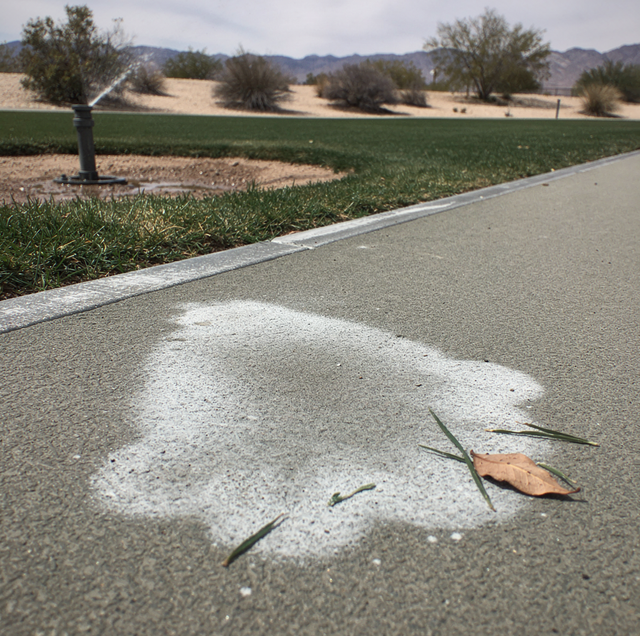
Yes. A sprinkler head that regularly clips the edge of a court can stain, streak, and soften the acrylic coating over time, and two things do it: the minerals the water leaves behind, and the constant wetting itself. Irrigation water carries minerals that remain on the surface when the water evaporates, building up in the coating's texture. Because the spray hits the same section every cycle, the damage concentrates in one predictable patch rather than spreading evenly across the court, which is why it's worth diagnosing separately from anything sun or age is doing to the rest of the surface.
What Does Overspray Water Do to an Acrylic Coating?
An acrylic court coating isn't a smooth, sealed sheet. It has a textured finish built in for grip and a slightly porous surface over a flexible acrylic binder. When irrigation water lands on that texture and evaporates, the minerals it was carrying don't go anywhere; they settle into the peaks and valleys of the texture and build a chalky film that dulls and discolors the coating underneath. A single cycle leaves a film too thin to notice. Repeated cycles on the same strip are a different story, because each cycle adds a thin layer to what's already there. The deposit is calcium and magnesium carbonate, and it forms a thin, chalky layer that rests on the surface rather than reacting with the underlying coating.
Constant wetting adds a second problem to the mineral buildup: it keeps that section of the coating damp longer than the rest of the court, cycle after cycle. Where that damp patch also sits in shade for part of the day, whether from a fence, a tree, or the court's own shadow at certain hours, the combination of moisture and reduced sun can grow a thin film of mildew or algae on the coating's surface. That film reads as a dark, sometimes slick discoloration rather than the pale mineral haze, and the two can appear side by side on the same wetted patch. A wetted patch that never fully dries between cycles can also work moisture under a coating seam or a hairline gap over time, and that trapped moisture is one of the ways a small section of coating lifts or bubbles rather than just staining, which is a separate repair from a mineral deposit or a mildew film.
How Do You Tell Overspray Damage From UV Fading or Cracking?
Sun fading and overspray staining can both dull a court's color, but they don't look or behave the same way. UV fading spreads evenly across the entire court as the color coat ages, whereas a sprinkler head does not. Overspray staining, by contrast, sits in a defined patch or arc shaped like the spray pattern itself, near an edge or a fence line where a head sits closest to the court, and it looks chalky, blotchy, or faintly greenish rather than uniformly washed out.
Cracking is a different mechanism again: a structural line in the base telegraphing up through the coating, which shows as a thin dark line rather than a discolored patch, and moving or repositioning a sprinkler head does nothing to fix it. The table pairs what you see on the court with overspray or the other two causes.
| What You See | Overspray or Something Else |
|---|---|
| Chalky, pale patch confined to one edge or corner | Mineral deposit from irrigation overspray |
| Dark or faintly greenish film in a shaded, damp patch | Mildew or algae from constant wetting |
| Even, gradual dulling across the whole court | UV fading, not overspray |
| Thin, linear dark crack, may follow an old joint | Base movement or a coating crack, not overspray |
| Texture feels rougher or grittier in one small area | Mineral buildup loaded into the coating's texture |
If a patch lines up with a sprinkler's throw distance and gets wet on schedule, overspray is more likely than sun or structural movement.
Redirecting Heads and Adjusting the Irrigation Timing
Once a wetted patch is confirmed, the fix starts with the irrigation system rather than the court itself, and it's a landscaper's or irrigation technician's job, not a court contractor's. Adjusting a head's arc so its throw stops short of the court edge, swapping in a nozzle with a shorter or narrower pattern, or adding a shield or deflector at the base of the head can all prevent water from reaching the surface. Moving the watering schedule to hours when the court isn't in use doesn't stop the wetting itself, but it does mean nobody is playing on a slick, freshly sprayed patch while the head is being fixed.
Run the zone manually on a dry court in daylight and look for the wet edge on the coating. Where that edge meets the court tells you which head is reaching it, and how far its throw needs to come back.
How Do You Clean Mineral Deposits Without Damaging the Coating?
Light mineral buildup responds to a soft-bristle brush and a mild cleaning solution made for acrylic sport surfaces, worked into the texture and rinsed thoroughly afterward so the dissolved minerals don't just resettle as the water dries.
What doesn't belong on an acrylic coating is anything abrasive or corrosive. Acid-based cleaners and rust or scale removers can react with the coating itself, not just the mineral film sitting on top of it, and a stiff wire brush can scuff the texture in a way that's difficult to blend back in later. A pressure washer held close to the surface can strip the coating in the exact spot it's aimed at, turning a cosmetic stain into a bare patch that needs repair.
Acid-based cleaners and scale removers can burn skin and eyes and give off harsh fumes, and a pressure-washer jet can cut skin at close range. Leave a badly etched or stripped patch to a resurfacing crew rather than treating it at home.
When Does Overspray Damage Call for a Resurface?
Cleaning resolves surface-level buildup that hasn't worked its way into the coating itself. When a patch stays discolored after a proper cleaning, when the texture in that spot feels visibly different underfoot or under a ball, or when mildew has stained so deeply that scrubbing lightens it without restoring the original color, the coating in that section has moved beyond a cleaning fix. At that point, resurfacing the affected area, or the court as a whole if the patch is large or centrally located, restores both the appearance and the texture rather than leaving a visibly different patch where the sprinkler used to hit.
A quick field check for which side of that line a patch falls on: run a fingertip across it once it has dried. A deposit that's still surface-level feels chalky and rubs off as a fine powder, while a patch that stays embedded after a proper cleaning is a sign the coating itself needs attention, not just a cleaning.
Getting the irrigation issue corrected before any resurfacing work happens matters as much as the resurfacing itself. A freshly coated court with the same sprinkler head still spraying water onto it will develop the same stain in the same spot, on the same schedule.
Frequently Asked Questions
Yes. Water with dissolved iron, or an irrigation system that feeds fertilizer through the lines, can leave an orange or rust-brown stain inside the spray arc instead of the white carbonate haze. That stain is a different deposit and will not lift with the same mild cleaner that removes a chalky film.
Not the spray-shaped staining, since drip emitters and bubblers do not throw water onto the surface. A planting bed kept wet right against the court edge can still let water in from the side, and that shows up as coating lifting or cracking along the perimeter rather than an arc-shaped stain.
Not on its own. A clear topcoat can make a mineral film easier to wipe away, but water still sits on that patch with each cycle, so the mildew and softening carry on. It is a finish choice at resurfacing time, not a substitute for moving the head.
It can. Water drawn from a well or another private source can carry more dissolved minerals than treated municipal water, so two properties with an identical sprinkler pattern can end up with different amounts of buildup on the same size patch. The spray pattern is one factor that determines how quickly a stain forms; the water's mineral load is the other.
Not always on its own. A shield blocks direct spray at the height and angle at which it's mounted, but wind can still carry a fine mist past it on a breezy day. Pairing a shield with a redirected arc closes the gap that a shield alone can leave.
Not directly, as long as it's caught while it's still a surface-level mineral or biological buildup. The base underneath isn't affected by mineral deposits sitting in the coating's texture. Left long enough for the coating itself to degrade in that spot, the base loses the protective layer that keeps it from taking direct water and wear.
Reserve a court evaluation for the patch your sprinklers keep hitting — a look at whether the stain cleans out or the coating in that section needs resurfacing. CourtMaster Sports, Inc. serves the Coachella Valley and Las Vegas. Call (760) 548-3545 in Palm Springs or (702) 825-8818 in Las Vegas.