
Tennis Court Resurfacing vs Full Replacement: How to Decide
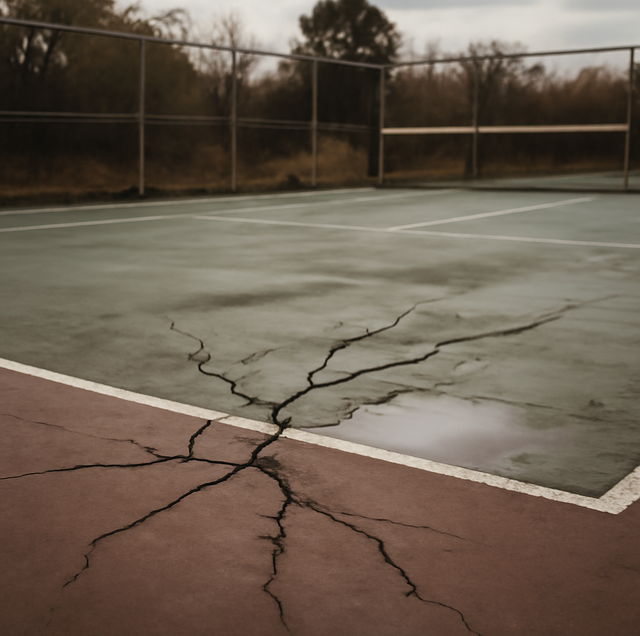
The color has faded, cracks are spidering across the baseline, and water pools in a low spot after it rains. Your court has clearly reached a decision point, and the question is whether a fresh surface will bring it back or whether the whole thing needs to come out and start over. The answer is not about how tired the court looks. It is about what is happening to the base underneath it.
Resurfacing and full replacement solve very different problems. Resurface a court that needed rebuilding, and the new coating cracks again within a season; rebuild a court that only needed resurfacing, and you spent far more than the problem called for. The base tells you which one you have.
The Surface Is Not the Structure
A hard court is really two things: a base of asphalt or concrete that provides the structure, and a system of acrylic color coatings on top that you actually play on. Those coatings wear out on a schedule, which is why courts are resurfaced every four to eight years or so, depending on use, climate, and maintenance. Resurfacing cleans and repairs the surface, fills minor cracks, and lays fresh coatings and lines. It restores the court you play on without touching the structure below.
Replacement is a different scale of work. It means removing and rebuilding the base itself, because the structure, not just the surface, has failed. So the real question when a court looks rough is whether the trouble lives in the coatings, which resurfacing handles, or in the base, which only replacement can fix.
When Resurfacing Is the Answer
Resurfacing is the right call when the base is sound, and the problems are on the surface. Faded or worn color, a slick or slippery surface, minor surface cracking, worn-off lines, and small low spots that hold a little water are all surface-level issues a quality resurface addresses. If the court is simply due, coatings age out on their cycle; a resurface renews them and resets the clock for several more years.
The signal that resurfacing will hold is that the base is still stable: the cracks are shallow and not moving, the court is not heaving or settling, and the structure drains and sits as it should. When the bones are good, and only the skin is worn, resurfacing is the efficient, correct choice.
When Replacement Is the Only Real Fix
Replacement becomes necessary when the base has failed, and cracks are usually how it announces itself. Structural cracks, the wide, deep, or recurring kind that keep coming back no matter how many times they are filled, mean the base is moving, and no surface coating can bridge a base that shifts underneath it. Large depressions or heaving, sections that have settled or lifted, and drainage that has clearly failed all point at the structure rather than the surface.
The clearest tell is a crack that returns. Fill and coat over a working structural crack, and it will telegraph right back through the new surface, because the movement below never stopped. When cracking is widespread, when the base is crumbling or unstable, or when a court has simply reached the end of its structural life, resurfacing only buys a short reprieve, and rebuilding the base is what actually solves it.
| Lean toward resurfacing when… | Lean toward replacement when… |
|---|---|
| Color is faded, surface is worn | Base is cracked, heaving, or settling |
| Cracks are shallow and stable | Cracks are wide, deep, or keep returning |
| Small low spots hold minor water | Large depressions or failed drainage |
| The court is simply due for coatings | The base has reached end of life |
| Structure is stable underneath | Structure is moving or crumbling |
Why Heat and Sun Are Hard on Courts
Intense heat and strong sun age a court faster than a mild climate does, on both levels. On the surface, the sun fades in color and wears coatings, which is why courts here often need resurfacing on the shorter end of the cycle, closer to every five to seven years. Below the surface, big daily temperature swings drive the base through constant expansion and contraction, which is one of the main forces that open structural cracks over time. That combination is why reading the cracks matters so much here: the climate produces both the harmless surface aging that resurfacing fixes and the structural movement that eventually calls for replacement, and telling them apart is the key to spending right.
Frequently Asked Questions
A standard acrylic resurface is built in layers, not a single paint pass. Crews typically start with one or two coats of an acrylic resurfacer filled with sand to fill fine texture and level the old surface, then two color coats that carry the silica sand, which sets the pace and grip of play, and finish by re-striping the lines. That is why a proper resurface takes several days of cure time between coats and why a rushed single-coat job wears through fast. Court-sport bodies such as the ASBA treat this multi-coat cycle as the norm for maintaining consistent pace and traction.
The base often signals trouble ahead of the coatings. Watch for edges of the court that are sinking or pulling away from the perimeter, birdbaths that grow bigger or deeper season over season rather than staying put, and a hollow or drum-like sound when a section is tapped, which can mean the coating has debonded from a base that is breaking down beneath it. On asphalt bases, raveling, loose aggregate working up through the surface, points to the binder failing. Catching these signs early can mean a base repair rather than a full teardown later.
For a live crack not tied to a major base failure, crews sometimes install a crack-repair membrane system rather than just filling the gap. These layered systems, a fabric or a reinforced elastomeric membrane bonded over the routed crack, are engineered to move with the crack and absorb some of that flexing so the color coats above stay intact longer. They buy time and can hold for a few seasons, but they are a managed repair, not a permanent cure: a membrane over a base that is actively shifting will eventually still show the crack, which is when replacement becomes the honest answer.
It changes the whole crack picture. Post-tensioned concrete is cast as a single reinforced slab held in compression by internal steel cables, so it is built to resist the random structural cracking that opens up in asphalt and standard slabs; when it is the base, cracks are far less common and, when they appear, they warrant a careful look rather than a simple fill. Asphalt bases flex and oxidize with age, so they tend to show more surface and structural cracking over time. Knowing which base you have tells you how seriously to read a crack and whether a repair is likely to hold.
Court-sport standards give a concrete test: after rain, a puddle deeper than the thickness of a nickel laid flat, roughly a sixteenth of an inch, is generally considered a birdbath worth correcting. During a resurface, small ones are patched by feathering acrylic patch binder into the low area in thin lifts until water sheets off. What that patching cannot fix is a whole quadrant that ponds because the base was built without enough slope; a hard court needs roughly a one percent pitch to drain, and if the base lacks it, no amount of surface coating creates it.
Simple upkeep meaningfully extends a court's coating life. Keeping the surface clear of leaves, dirt, and standing water prevents the organic staining and slow acrylic breakdown that shortens a cycle, and a low-pressure wash a couple of times a year lifts embedded grit that grinds the color coats. Trimming back trees cuts UV load and sap, addressing hairline cracks while they are still hairline, stops water from getting under the coating and freezing or spreading, and squeegeeing puddles after rain in intense heat limits the thermal stress of standing water baking on the surface. A court that is routinely cleaned and spot-maintained often reaches the longer end of its resurfacing interval rather than the shorter one.
Read the Base, Then Decide
Whether a court needs resurfacing or full replacement is answered underneath, not on top. Faded color, worn coatings, and shallow, stable cracks are surface problems that resurfacing renews on its normal cycle. Wide, deep, or recurring cracks, heaving, and failed drainage are the base issues telling you it has moved or worn out, and only rebuilding fixes that. Judge the structure, watch whether cracks return, and you will spend on the repair the court actually needs.
If your court is cracking or fading and you are not sure whether to resurface or rebuild, an assessment of the base will tell you. CourtMaster Sports, Inc. serves the Coachella Valley and Las Vegas. Call (760) 548-3535 for a consultation.
