
What Causes Glare on a Court, and Why More Light Won’t Fix It
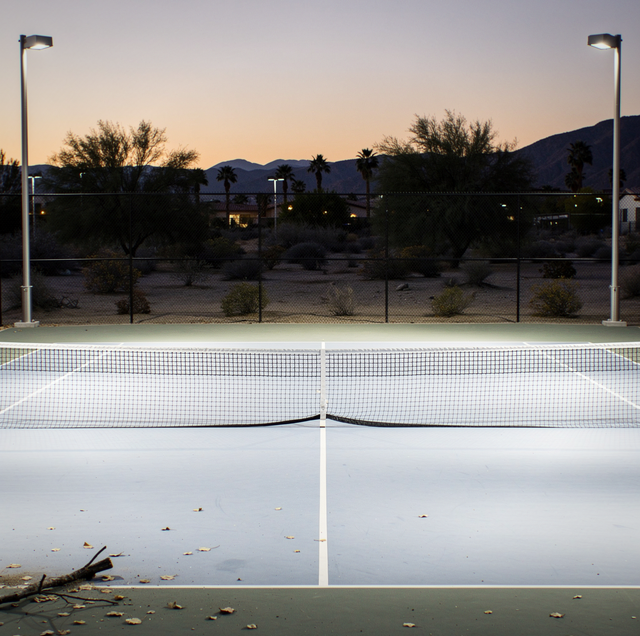
You toss for a serve, and the ball is gone at the top of the toss. Not dim, not hard to pick out: gone, for about a third of a second, and back in view already falling toward the racket. The lights are on. The court is bright. You cannot see the ball at the one moment you need to, and the first instinct, to add fixtures or turn the system up, reaches every cause of that and improves none of them.
Four Sources of Glare, and What More Output Does to Each
Four separate things produce a lost ball, and they do not answer to the same fix. The fixture can sit in your line of sight. The surface can throw light back up at you. The court can be so much brighter than everything around it that your eye stops resolving anything past the lines. And the light on the court can be uneven enough that the ball dims and brightens as it crosses.
Lighting practice splits what a player calls glare into two halves, each measured differently. Disability glare is a loss of contrast: light from a bright off-axis source scatters inside the eye and casts a faint veil over the retinal image, so the ball appears less distinct against its background. Discomfort glare is the squint and the flinch that can occur even when you are still seeing the ball clearly. Both are contrasts, and fixture output sits on both sides of each. Raise every fixture together and the veiling light climbs, the surface returns more, and the ratio barely moves.
Uniformity is the fourth, and it produces a complaint that sounds exactly like glare. As a ball crosses from a bright pool into a dim gap, the light coming off it falls faster than local adaptation can follow, so it dims, then brightens on the way out. Send a fast ball across three of those transitions, and the effect is indistinguishable from being dazzled, though nothing is pointed at anyone. The gaps scale with the pools, so an uneven court is twice as uneven at twice the brightness.
Which fixture ends up in the sightline is a matter of optics, mounting height, and aiming angle, and that half of the problem is a separate design question. The three sources below are the ones no fixture choice reaches, and two of them are settled before a pole is ever set.
Reflected Glare Is Set by the Surface Underneath You
Every lumen that reaches the court is either absorbed by the coating or reflected off it, and how much comes back and in what direction are determined by the color coat. That is a surfacing decision, settled years before anyone argues about the lights.
Direction comes from texture. An acrylic color coat carries fine silica sand for grip, and that micro-texture scatters incoming light across a wide spread of angles, so no mirror direction dominates. A smoother finish, from a lighter sand load or from years of play polishing the high points down through the service boxes, holds the mirror angle better. When that angle lands at eye height on the far side of the net, the court beneath it reads as a sheet of light rather than a surface, and a low ball crossing it goes into the sheet.
Quantity comes from shade, and it cuts both ways. A pale court returns a larger share of what lands on it, sending more light back toward the eye and washing out a ball hit low and flat. A dark court returns very little, leaving the fixtures the brightest objects in view by a wider margin and making every other source on this list bite harder. The two failures are opposite; they are both real, and there is no shade that has neither.
Shade is also chosen for reasons that have nothing to do with a player's eye: how it holds color in the sun, how hot it runs underfoot, how well it hides wear. Those conversations happen at surfacing time, with a lighting system that may not exist yet. On a court that already has lights, reflected glare stays exactly where it is until the next resurfacing, which is what makes it the one source no service call can move.
A Dark Surround Makes a Well-Lit Court Play Dark
The eye has no absolute brightness scale. It sets an operating point from the average luminance filling the field of view, then judges everything against that. Play at night on a lit court with unlit ground past the fence, and the operating point is the court itself, so everything outside the lines drops below what the adapted eye can resolve, and the surround goes black.
Two failures follow. A ball that leaves the lit volume, high on a lob or far past the baseline, stops being visible even though nothing is shining at you, and returns only when it re-enters the lit zone. And the fixtures become the only bright objects in a black field, which is the condition under which discomfort glare is worst. The same fixtures at the same output are far easier to play under at dusk, while the sky still carries light, than they are an hour later.
An eye adapted to a lit court reads an unlit path poorly until cone adaptation runs its course, roughly five to seven minutes. Keep steps, gates, and benches inside the lit area or on their own low-level fixture.
The lever here is the surround, and it is the one no work on the court fixtures reaches. A modest amount of light on the fence line, the walkway, and whatever sits behind the baselines gives the eye a background and pulls down the ratio between the court and everything else. There is a real tension in this: court fixtures are chosen partly for how little they spill past the fence, which keeps a backyard court out of a neighbor's bedroom window, and that restraint is what leaves the surround dark. So the surround gets its own low-output fixtures, aimed at the ground and sized to lift the background rather than add court light. A few foot-candles on a walkway move that ratio further than another kilowatt on the court.
The Numbers That Settle a Glare Argument
Glare on a sports surface has a number. CIE 112 defines a glare rating, GR, computed from the veiling luminance the fixtures produce at the observer's eye set against the veiling luminance of the lit surroundings. That second term is dominated by light coming back off the playing surface, so the surface shade sits inside the glare number itself: change the coating and the calculated GR changes with it, on a court where nothing about the lighting moved.
Fixture spec sheets carry an IES TM-15 BUG rating. The U digit counts lumens above horizontal, where U0 means none, and the G digit scores the high-angle lumens that reach a player's eye.
Uniformity has its own numbers, and they are the ones a meter can settle in an afternoon. IES RP-6, the recommended practice for sports and recreational area lighting, works in the ratio of maximum illuminance to minimum across a measurement grid on the playing surface. All of them describe how much the light varies across the court. A design gets checked against those figures before anything is built, and a built court gets rechecked with a light meter walked across the same grid.
What Can Be Changed on a Court That Already Has Lights
Adding perimeter light is the smallest change on the list and the only one that touches adaptation. It needs no work on the court fixtures, which is why it is worth doing first even when something else is also wrong.
Re-aiming comes next, because it needs no new equipment and it moves the fixture side and uniformity together. A fixture tipped a few degrees further down pulls its high-angle output out of the sightline band and drops it on the far quarter of the court, the part a level aim was overshooting. Visors and louvers go further, with a caveat worth knowing before ordering them: they work by subtraction, and the high-angle lumens they block include some that were reaching the far side, so court levels fall, and uniformity can worsen while glare improves. Fitting them means re-checking the aiming afterward and re-measuring court levels once they are on.
Re-coating is the one change that touches reflected glare, and it belongs in the plan only when the surface is due for resurfacing anyway. That timing is worth watching: it is the moment a decision that governs reflected glare for as long as the coating lasts gets made by whoever is picking a color, in a conversation the lighting is not part of.
Frequently Asked Questions
Haze, humidity, and airborne dust scatter light between the fixture and your eye, adding a veil no aiming change removes, so a fixture reads as a halo rather than a point. Dew does something separate: moisture fills in the sand texture of the coating and turns a diffuse surface temporarily specular, so a court that has never shown a reflected sheet can show one at ten at night and lose it again by morning.
Raising a pole improves the aiming geometry, and it does not simply cost light. Illuminance on the playing surface equals the fixture's intensity times the cosine of the incidence angle, divided by the square of the distance; raising a pole increases the distance and the cosine at the same time. Near the base, the distance term wins and levels fall. At the far end of the court, the cosine term wins: taking a tennis pole from twenty feet to thirty feet raises illuminance at the far baseline corner by roughly seventeen percent. Levels get recalculated after a height change rather than assumed to drop.
Dimming on a 0-10V or DALI driver lowers the fixture and the surface it lights together, so the ratio holds and the glare sits about where it was. Where it earns its place is dusk: matching output to a sky that still carries light keeps the court from becoming the only bright thing in view before it has to be. Stepping down for casual rallying also spares the driver, the component that ages fastest in an outdoor housing.
LED output falls across service life. LM-80 measures the decline on the LED package, TM-21 projects it forward, and L70 marks the point at which a fixture has dropped to 70 percent of its initial output. The decline is even across a fixture, so the glare ratio barely shifts. Trouble arrives when one fixture fails and gets replaced on an aged system: the new one outshines its neighbors and becomes a single dominant source in the same field of view.
A basketball goal changes what gets measured. On a flat playing surface, the governing number is horizontal illuminance at the ground, but a shooter looks up at a vertical target, so the measure that matters at the backboard is vertical illuminance on that face. The goal also creates a steep sightline, which puts any fixture behind or above the backboard in the shooter's view on every attempt.
A solid windscreen is hung to block wind and provide a plain backdrop behind the ball. It also blocks whatever light exists on the other side of the fence, deepening the contrast between the lit court and everything around it, and hides any perimeter fixture mounted outside the fence line. Surround lighting on a screened court has to sit inside the screen or high enough to clear its top rail, or the fabric takes the light and the surround stays dark.
A court lighting design review — surface return, surround levels, aiming, and uniformity measured before anything gets re-aimed or re-coated. CourtMaster Sports, Inc. serves the Coachella Valley and Las Vegas. Call (760) 548-3545 in Palm Springs or (702) 825-8818 in Las Vegas.
