
Court Crack Repair Methods: Which Fix Your Crack Needs
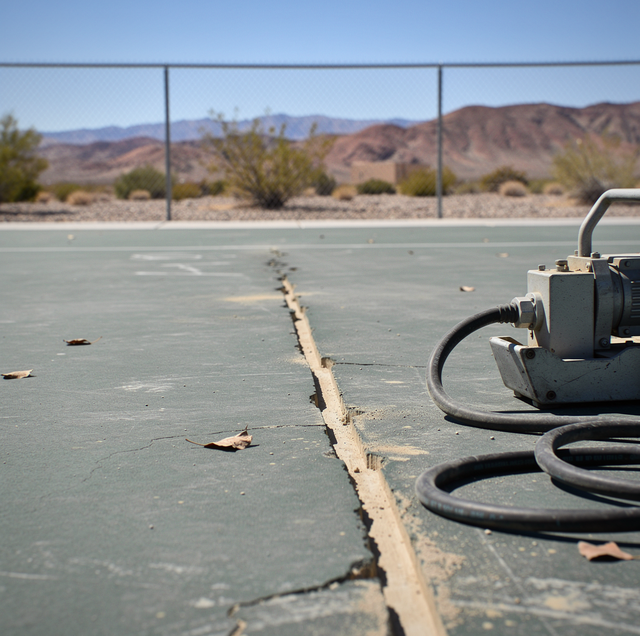
Four different jobs get quoted as crack repair on a hard court, and they are not four grades of the same service. One routes the crack open and fills it. One adds a reinforced layer over that fill. One saws out the failed pavement and rebuilds that section. One rebuilds the base under the whole court. They sit on a ladder, each rung more disruptive and longer-lived than the one below it, and the money question on any cracked court is which rung the line in front of you actually calls for.
Getting that wrong costs twice. Buy a rung too low and the crack reopens inside a season or two, usually in the same place, and the next repair starts over from the beginning. Buy a rung too high, and you rebuilt pavement that had years of service left in it. What separates the two is knowing what each method physically does, the conditions that let it hold, and how many attempts at the low end are reasonable before the honest answer sits higher up.
Open the Crack Before You Fill It
Every method on the ladder except full reconstruction starts the same way. A crack router or a small saw follows the line and cuts it open to a deliberate profile, usually a shallow V or a square kerf roughly a quarter of an inch across and a similar depth, and the loose debris gets blown or vacuumed out before anything goes back in.
That cut earns its cost three times over. It gives the sealant two vertical faces to bond to, one on each side of the opening, rather than a thin smear clinging to the coating's surface. It opens a channel with sufficient cross-section that the filler behaves as a body of material rather than a film, so it can stretch and compress with the movement below it rather than tear on the first cycle. And it takes away the ragged, dust-packed edges of the old crack, which is exactly the loose material a filler would otherwise be gripping.
A repair skimmed across an unopened crack usually lets go along its own edges within a season. From ten feet away, that failure looks identical to the crack itself returning, which is why skim repairs get blamed on the base when the bond line was the part that gave out.
Save the batch and product name of whatever filler goes into the crack. If the line reopens, knowing whether it was a flexible sealant or a rigid patch compound tells the next crew whether the material or the movement gave out.
What Goes Into the Routed Channel
The filler class matters as much as the channel profile does, and court crack work generally chooses between two material families.
Flexible sealants, typically urethane or elastomeric acrylic compounds, remain soft after curing and move with the crack. That flexibility is the whole point on a line that opens and closes with the seasons, but a soft filler collects grit, can be squeezed slightly proud of the surface when the crack closes in hot weather, and never sands down to a hard, invisible edge.
Semi-rigid patching compounds, usually an acrylic patch binder loaded with silica sand or an epoxy-modified filler, cure hard, sand flush, and accept color coat cleanly. On a dormant crack, they give the better finish. On a working one, they behave like a stiff glue line across a piece of plastic that keeps bending: the material itself holds fine and releases at its edges instead.
Most crews split the difference. A flexible sealant goes into the routed channel and is struck flush or a hair below the surface, then a sand-filled acrylic patch binder is feathered over the top in thin lifts, spread wide enough that the repair reads as level rather than as a ridge under the new color. Filling proud of the surface is the common shortcut, and it leaves a hump that shows through two color coats and changes how a ball comes off that line.
The Four Repairs, and What Each One Buys
Each rung answers a different scope of failure rather than answering the same failure better.
Routed and filled crack repair: A flexible sealant in a routed channel, patched flush and coated over. It buys a season or two on a line that is still moving, and it can hold for years on one that has gone quiet. It fits a single line where the pavement on both sides still sits at the same height, and no depression runs along it.
Fabric or membrane crack-repair system: A reinforced layer bonded over the routed and filled crack before the color coat goes down, either a fabric set into an acrylic slurry or a reinforced elastomeric membrane. Rather than asking a thin coating to bridge a knife-edge gap, it spreads that movement across a band several inches wide. It buys several seasons of the line staying invisible on a crack that works seasonally without one side stepping up or down.
Full-depth patch. The failed section is saw-cut out through the full thickness of the pavement, the material below it is repaired and recompacted, and the section is rebuilt and tied back into the surrounding surface. It is the first rung that removes a failure instead of managing one, and it suits a defined area rather than a court-wide condition.
Reconstruction. The base comes out and goes back across the entire court. It is the answer once the failure is general rather than local, and it is the only rung that also resets pitch and drainage geometry, which matters when the same court shows both cracking and standing water.
| Repair | What it buys | Where it stops working |
|---|---|---|
| Routed and filled | A season or two on a working crack | A vertical offset, or a third reopening |
| Fabric or membrane | Several seasons of an invisible line | Movement large enough to shear the band |
| Full-depth patch | A lasting fix for one defined area | Settlement spread across the court |
| Reconstruction | A rebuilt base and corrected pitch | Nothing, but it closes the court for weeks |
Cutting a Full-Depth Patch Wide Enough to Hold
The size of a full-depth patch is set by the saw cuts around it, and those cuts land well outside the visible damage. Cutting tight to the crack leaves compromised pavement standing at the patch perimeter, and that new edge fails the way the old crack did, except now there are four of them boxing in fresh material.
Sound practice is to square the cut, carry it past the distress into pavement that rings solid underfoot, and treat everything inside those lines as disposable. What comes out matters as much as what goes back. If the material under the removed section is soft or saturated, rebuilding the pavement alone puts a new slab over the same void the old one left behind, so that layer is dried, replaced, or recompacted in lifts first.
Two details decide how the patch reads a year later. Thickness and material should match what came out, since a thin patch flexes on a different rhythm than the pavement around it. And the finished patch has to match the pitch of the surrounding court, because a section set even slightly low turns into a puddle sitting directly over the spot that already failed once.
Routing or saw-cutting concrete dry throws respirable silica dust, which is a lung hazard rather than a nuisance. Crack work on a slab should be wet-cut or run with vacuum dust collection, and anyone standing nearby needs to be upwind.
Cure Windows and Weather Set the Schedule
Every rung on the ladder carries its own waiting period, and those windows are why crack work gets scheduled rather than done on demand.
Sealants and patching compounds need a stretch of dry, settled weather to set up, generally at least several days before acrylic goes over them, and a concrete full-depth patch needs considerably longer than that before it will take a coating at all. Color coat applied over an undercured patch is one of the more reliable ways to lose a repair inside a single season.
Temperature is the part most often read wrong, because people read the air. Acrylic coatings and most court sealants want a surface temperature of at least 50 degrees Fahrenheit and rising, with no forecast dip below that overnight while the film is still setting. A slab holds cold for hours after the air has warmed, so an air reading in the mid-fifties on a cool morning can sit over pavement still in the forties, and the coating cures against the pavement, not the thermometer. The same lag runs the other direction in heat: a surface hot enough to pull water out of an acrylic coat before it levels leaves a brittle film that fails early, which is why hot-weather work moves to early morning, while cold-weather work waits for midday.
Two Fills, Then Move Up the Ladder
Two attempts is the working number. A crack that reopens in the same line after two separate fill-and-recoat cycles warrants a full-depth patch, and a third round of the same repair is money spent on an experiment that has already run.
The reason behind that count is worth stating plainly, because it is more than a budget rule. A filled crack that reopens has already reported its outcome: the sealant bonded, the channel held, and the movement below was greater than the repair could absorb. Running it again tests nothing new. Each cycle also makes the next repair harder, since every re-rout takes out a little more sound pavement at the edges and leaves a wider, weaker channel for the following filler to bond into. Three fills and the coating work that rides along with each of them tend to add up to something close to the patch that was being put off.
The rule has one boundary worth keeping straight. It counts the same line reopening in the same place. A new crack somewhere else on the court is a separate case that starts its own count, and a repair that holds through two full seasonal cycles has passed rather than merely delayed the question.
Frequently Asked Questions
Often, yes. Pooling in the low spot created by uneven settling reveals a depression from underneath before it's deep enough to hold standing water on its own. A crack that seems to vanish between rains but reappears wet every time is frequently an early birdbath, not just a coating issue, and is worth logging the same as a standing puddle.
Not usually. Cracking within the first year or two more often traces back to how the court was built, such as cure time, joint spacing, or sub-base compaction, while a crack that appears after many years of service is more likely to be gradual settling, freeze-thaw cycling, or root growth. The cause changes which fix makes sense, so it's worth mentioning the timeline to whoever assesses it.
Yes. Edge cracks sit closer to planting beds, irrigation overspray, and any nearby root systems, so they're more often tied to water and root intrusion. A crack toward the center of the court more often points back to the sub-base itself, since it's farther from those outside influences.
Not in the same way. A fill that splits down the middle of the old channel means the sealant or its bond gave out under movement it couldn't absorb. A fresh line running parallel, an inch or two away, usually means the repair itself held, and the pavement relieved the same stress at the next weakest point, which argues for a wider fix rather than a different filler.
Usually, yes. Because the repair and its curing are localized to the affected section, only that area typically needs to be taped off while the patch material sets, unlike a full resurface, which generally takes the whole court out of play at once.
Often before you'd expect. A slight dip or offset from settling can change bounce and pace at that spot before the line itself is visually obvious, so an odd bounce in one recurring location is sometimes the first real clue, worth treating as a diagnostic sign on its own.
Schedule a crack repair assessment — find out which repair a cracked court actually needs before a third round of filling. CourtMaster Sports, Inc. serves the Coachella Valley and Las Vegas. Call (760) 548-3545 in Palm Springs or (702) 825-8818 in Las Vegas.
