
Does a Court Slab Need a Perimeter Curb to Last?
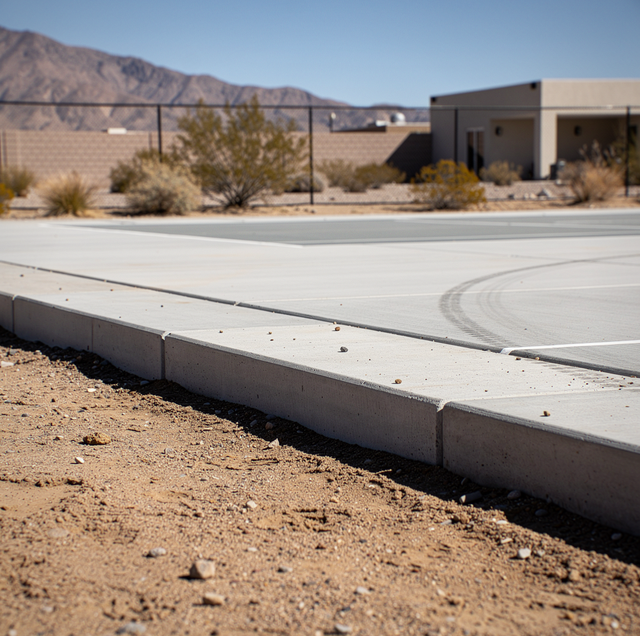
Ask what holds the edge of the slab, and listen for whether you get the name of a part or only a step in the schedule. The part has a name. A perimeter curb is a formed concrete edge that runs the boundary of the pad and sits inside the fence line, built to the same plane the playing surface will be finished to. Whether your court gets one depends on what the slab is made of and what goes on top of it, and that belongs on the drawing before anyone orders material. What does not change is that a curb has work to do at two moments, in the order the court meets them: the pour first, and the years after it second.
At the Line Where the Color Stops
A curb is the one boundary of your court you can put a hand on. It stands where your surfacing stops, a continuous band of concrete following the outline of the pad, and on a court built for modular tile over asphalt, that curb section runs about twelve inches wide and roughly six inches deep. That figure applies to new asphalt courts receiving a tile surface and does not apply to a poured acrylic system on concrete.
Other members do a version of the same job on other assemblies, and neither is a curb. On some concrete-base assemblies, a six-by-six-inch turndown runs at the slab perimeter, scoped to where a slab abuts walls or other pavements. A post-tensioned tennis or pickleball court instead uses a twelve-by-twelve-inch perimeter beam with the strand anchorages seated about four inches below the finished surface, a structural member holding a stressed slab in compression. Different assemblies, different cross sections, and a dimension taken from one of them tells you nothing about the others.
A Form That Never Comes Off
Every court slab is placed against something. A form has to hold a line and a grade while material is pushed against it, and whatever the concrete is struck off to becomes the finished plane of your court. On a court with a curb, the curb is that something.
The tolerances are tight. On a post-tensioned court, forms are set to the lines and to within a quarter inch of the finished grades on the drawings. On a reinforced concrete court, the fall of the finished surface runs between 0.83 and 1 percent. A form set half an inch off has already broken both of those tolerances before the truck reaches your site.
A form also confines. Base material placed inside a formed area is compacted against the form face, and the paving is screeded to it. On a post-tensioned slab built to that kind of specification, the concrete is laid with a laser screed, holding a quarter inch in ten feet across a 1 percent slope. Neither happens against a free edge of loose ground.
Then the boards come off. On a court without a curb, that is the end of the form's life, and your slab is left with a bare vertical face and the base standing against it. On a court with one, nothing comes off, and the part that held the line during the pour is still there holding your ground.
Holding the Base After the Concrete Has Cured
The ground that supports a court does not stop where the paint does. Site preparation strips topsoil and other unsuitable material for at least five feet beyond the surfaced area, and the fill that replaces it goes in in lifts no thicker than six inches, each compacted to at least 95 percent of maximum density under a standard compaction test. Those built-up layers run wider than anything a player ever stands on, and their outer face is exposed ground. A curb confines that face. Take the curb away, and the last few feet of base is a slope of compacted aggregate held up by friction, with your slab bearing on top of it.
Water compounds it. A court falls in a single plane, so every drop that lands on your surface leaves across one edge, and that edge has the least ground behind it. A curb turns the discharge line into a hard face the water runs past instead of into. That face is a construction line, laid out from the lot before any base goes in.
The ground outside works on it as well. Grass and turf growing above the concrete curb edge is a known cause of ponding at the court edge behind it.
An Unconfined Edge Loses Ground From Underneath
At an unconfined perimeter, the support under the last slab band fails first. Aggregate at a free face migrates. Rain moves fines out of it, and irrigation on the ground outside your fence saturates it from the side. The band of base directly beneath your slab edge loses its shoulder, and the concrete above it is then spanning ground it used to bear on.
Asphalt courts feel it sooner. A hot mat pushed by a roller has nothing to push against at a free edge, so the outer strip moves outward while the field compacts downward. A concrete curb belongs around the perimeter of a new asphalt court for a second reason too, as the member of a tile system fastens into it. Take the curb out of your drawing, and the asphalt edge and the surface anchorage go with it.
Reinforcing Stops Before the Slab Edge Does
The top of the curb at the low corner of a court sits a fraction of an inch off the color, and a foot finds it before an eye does. The surfacing hides how the slab behind it is put together. On a reinforced concrete court, the reinforcing bars are set at mid-depth and stop two inches short of the edges and joints, leaving the outermost two inches of the court slab without steel. Some concrete-base assemblies address the same problem in a different way, by running a #5 continuous bar along the perimeter of the slab. Both are about the same band of concrete, and it is the band a missing curb leaves standing alone.
The exchange is lopsided. Removing the curb takes one item out of the work, leaving the form job and the boundary job with nothing assigned to them, and the two come due at different times. The form job is over the day the concrete is placed, and a court poured against stripped boards can finish true if they were set and held. The boundary job never ends, and a stripped-form court has nothing at the line to take it on. That asymmetry is why a curb looks removable on your drawing and does not behave that way in your ground.
On your own court, the check is short. On the low side, the concrete either stops at a vertical face, with the base showing against it, or steps up into a band of its own, with a joint between the two. The first was formed and released. The second is still being held, and it holds as long as the ground outside keeps moving.
Frequently Asked Questions
A joint, and a specific one. An expansion joint runs wherever new concrete abuts curbs, walls, or other rigid pavements, filled with a premolded joint filler and sealed with a sealant that resists oil and fuel. The two members then move independently, and neither cracks the other when your slab moves against it.
Inside. On a new asphalt court, the curb sits within the fencing, so it lands in the run-off band your players cross at speed. If your court is tight on run-off, that curb top is a change in level within the space you have, and its height belongs on the drawing rather than on the crew's judgment.
Form boards are temporary. On a post-tensioned court, forms are secured against settlement or movement while the concrete is placed, and then they come off. A curb is set to the same line and left in place, so your slab still has something at its edge on the day your court is handed over.
Out across one long side. A court slopes in a true plane, preferably side to side, never from the net line to the baseline, so your runoff arrives along a sideline instead of at a corner. Your drawing has to show where that face is broken, or your curb becomes a dam around your court.
No. The top edge takes a quarter-inch tooled radius or a chamfer, because a square arris concentrates the load along a line, whereas a radius spreads it. On a curb your players step across, that same detail keeps your edge intact instead of letting it crumble at the line.
Yes, and it is not the same part. A curb poured against cured concrete meets the slab at a joint instead of running continuously, so the two move apart the first time that edge settles or the slab swings through a wide temperature range. At handover, you cannot tell them apart.
Book a site visit while the court is still on paper — a curb is built to a width and a depth taken from the ground it will sit on, so those numbers come off a measured site before the base is ordered. CourtMaster Sports, Inc. serves the Coachella Valley and Las Vegas. Call (760) 548-3545 in Palm Springs or (702) 825-8818 in Las Vegas.
