
How a Sport Court Is Built: The 7 Layers That Matter
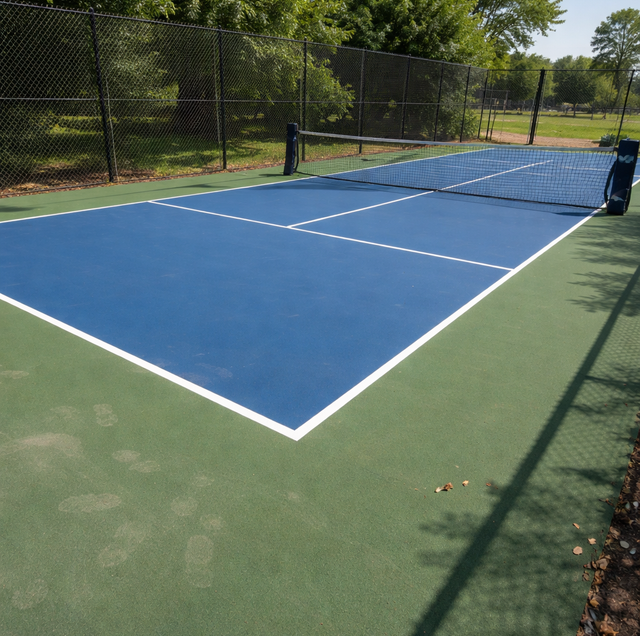
Quick Answer: A sport court is built from the ground up as a layered system: site layout and excavation, graded and compacted soil, a compacted aggregate sub-base, a reinforced concrete or asphalt slab, a full cure, an acrylic surfacing system (patch, resurfacer, then textured color coats), and finally net posts, fencing, and line striping. The base and drainage matter most, because a weak base telegraphs cracks up through the surface no matter how good the coating is.
A finished court looks like a single flat plane of color, so it is easy to assume the surface is the court. It is not. What you see is the thin acrylic skin on top of a stack of layers that started as a patch of dirt, and every layer below the color is doing more work than the color itself. A court that plays true for twenty years and a court that spiderwebs in two seasons can wear the identical blue-and-green finish. The difference was decided long before anyone opened a bucket of coating.
The useful way to understand court construction is as a dependent system. Each layer carries the one above it and only performs as well as the layer beneath. Grade sets up drainage, the sub-base carries the slab, the slab carries the surfacing, and the surfacing carries the play. Weakness anywhere low in the stack does not stay hidden. It travels upward and shows itself in the finish, which is why the parts of the build a homeowner never sees are the parts that decide whether the money was well spent.
Site Layout and Excavation
The build starts with string lines and stakes, not machines. The crew lays out the exact footprint, including the run-off margins beyond the lines that players actually use, then sets the finished elevation and the direction water will drain.
Locate underground utilities before any digging. A call to 811 gets gas, water, and electrical lines marked on the site. Cutting into an unmarked gas or electrical line during excavation is how a routine dig becomes an emergency.
Excavation strips off topsoil, roots, and any soft organic material, because those compress and rot over time and leave voids under the court. The crew digs to a depth that leaves room for the full stack of base and slab to come, and the exposed soil, the subgrade, is graded and compacted so it will not settle unevenly later. Uneven settlement under a court is one of the quiet causes of cracking that shows up years after the ribbon is cut.
Why the base and drainage matter most: The single most important idea in court construction is that a bad base telegraphs upward. A slab poured over soft or poorly compacted ground flexes under load, and concrete does not tolerate flexing. It cracks, and that crack reflects straight up through the acrylic as a visible line that no resurfacing fully hides. Spend on the base and the surface lasts. Cut corners on the base, and the finish inherits every one of them. The layers you cannot see are the ones worth paying for.
Grading for Slope and Drainage
A court is not built dead level. It is built as a single tilted plane so that water sheets off in one direction rather than sitting in puddles. The standard target is a gentle slope of roughly one inch of fall for every ten feet, and it runs in one plane, side to side or end to end or corner to corner, but not crowned or dished. That slope is shallow enough that play is unaffected and steep enough that a rain shower runs off instead of ponding.
Drainage is a safety and durability issue, not a cosmetic one. Water that stands on a court leaves birdbaths that grow algae and become slip hazards, and standing water works its way into any hairline opening and attacks the surface from above. Around the perimeter, the design has to move water away from the slab so it is not sitting against the edges or soaking back under the base. Getting the plane right during grading is far cheaper than trying to correct drainage after the concrete has cured.
The Compacted Aggregate Sub-Base
On top of the prepared subgrade goes a layer of crushed stone aggregate, often called the sub-base or road base. It is spread to a uniform thickness, usually in the range of four to six inches depending on soil conditions, then compacted in lifts with a roller or plate compactor until it is dense and stable. This layer does two jobs. It spreads the load of the slab and the players across the soil below, and it gives water a path to drain rather than pooling under the concrete.
The quality of compaction here is what separates a base that holds for decades from one that settles. A properly compacted aggregate layer behaves like a firm, continuous shelf. A loosely placed one hides soft pockets that later give way under the slab, and the slab cracks over each one. This is structural work, done with the right equipment and moisture control, which is why it belongs to a crew that builds courts rather than a weekend project.
The Slab: Concrete or Asphalt
The slab is the structural heart of the court, and it is either concrete or asphalt. Concrete is the more rigid choice and, for high-quality courts, the more common one. It is poured at a proper thickness, commonly four to five inches, over the compacted base. Asphalt is more flexible and is placed hot and rolled into two lifts. Both can carry an excellent court, but they crack and age differently, and the surfacing plan has to account for which one is underneath.
Reinforcement and crack control: Concrete shrinks slightly as it cures and moves with temperature over its life, and uncontrolled movement is what cracks a slab. Builders manage that in a few ways. Reinforcing steel, either welded wire mesh or rebar on chairs, holds the slab together and keeps any crack that does form tight rather than open. Higher-end courts use post-tension design, where steel cables are tensioned after the pour to actively squeeze the slab and hold it in compression, which strongly resists cracking on expansive or shifting soils. Standard slabs instead use control joints, deliberate saw-cut grooves that create planned weak lines so the slab cracks where the builder chose rather than at random. The goal is never to eliminate movement, which is impossible, but to decide where it goes.
Curing before anything else happens: Fresh concrete looks hard within a day, but it is still gaining strength and giving up moisture for weeks. It has to cure fully before any acrylic touches it. Coating over concrete that is still releasing moisture or is too fresh traps that moisture under the surfacing, and the coating blisters, peels, or fails to bond. A common minimum is around 28 days of cure, and the slab also has to test dry before surfacing begins. Rushing the cure to hit a deadline is a false economy, because the surface pays for it later.
The Acrylic Surfacing System
Once the slab has cured and tested dry, the finish goes on, and it is a system of coats rather than a single layer of paint. First the crew floods the court to find low spots, then patches any birdbaths and cracks so the plane is true. Next comes a resurfacer, an acrylic layer mixed with sand that fills the texture of the concrete and creates a uniform base for color. Then the color coats go on, typically two, each an acrylic pigment blended with silica sand.
The sand is what makes a court play like a court. It sets the pace and gives players grip and traction, and installers can dial the texture from a slower, higher-grip surface to a faster one by adjusting the sand. The final step before color, or between coats, is where the surface texture is locked in. Done right, the surfacing system is thin but tough, bonded to a sound slab, and built to be recoated years later without disturbing the layers below.
Net Posts, Fencing, and Lines
The last layer is the equipment and the markings. Net posts are not surface-mounted. They sit in concrete footings poured deep enough to resist the constant tension of a tightened net, and those footings are usually set before or during the slab work. Hence, they anchor into solid concrete rather than into surfacing. Fencing follows the same logic, with posts in their own footings around the perimeter.
Line striping comes last. The lines are laid out precisely to the sport's official dimensions, masked, and painted with a textured line paint that matches the surface so there is no lip at the tape edge to trip a player or catch a ball. On a court set up for more than one sport, the different sets of lines are usually painted in contrasting colors so players can pick out the right ones at a glance. When the last line is pulled, and the tape comes up, the layered system is complete, and the thin band of color on top is finally carrying the game it was built for.
Frequently Asked Questions
A new court from excavation to playable typically runs several weeks, and the schedule is driven by cure time, not labor. The base and slab work may take one to two weeks, then the concrete needs roughly 28 days to cure before surfacing, and the acrylic system itself needs several days because each coat has to dry before the next. Weather delays extend all of it, since coating cannot go down on a wet or too-cold slab.
Sometimes, and it depends entirely on the condition of what is already there. A structurally sound old slab with good drainage can be resurfaced or even overlaid, but a slab with a failed base, major cracking, or standing-water problems will pass those defects straight into the new surface. Builders assess the existing base first, because building over a bad slab wastes the cost of the new finish.
The structural layers are the same up through the slab. A cushioned court adds rubberized layers between the slab and the acrylic color coats, which gives underfoot forgiveness that is easier on knees and joints. A standard hard court skips those cushion layers and applies the acrylic system directly over the resurfacer, so it plays firmer and costs less to surface.
A tightened tennis net pulls its posts inward with hundreds of pounds of constant tension, year after year. A shallow footing lets the posts slowly lean, which loosens the net and can crack the surface around the base. Footings are poured well below the slab, often a couple of feet, so the mass of concrete resists that pull and keeps the posts plumb for the life of the court.
It affects the layout, not the layers. Courts are ideally oriented north to south so the low morning and evening sun is less likely to blind a player looking down the court, which is a layout decision made at the string-line stage. The slope direction is chosen separately, based on where water can best drain away from the site, so orientation and drainage are planned together before excavation.
Acrylic color coats wear and fade with sun and play and are typically recoated every several years, often in the five-to-seven-year range depending on use and exposure. Recoating stays entirely in the top surfacing layer. The crew cleans, patches, and applies fresh color and texture coats without disturbing the slab or base, which is exactly why a sound base is worth the investment: the structure lasts decades while only the thin finish is periodically renewed.
Planning a new court and want the base done right the first time — get a build assessment that starts from the ground up. CourtMaster Sports, Inc. serves the Coachella Valley and Las Vegas. Call (760) 548-3535 for a free consultation.
