
Single vs Multi-Sport Court: What Really Fits a Small Yard
Quick Answer: A single-sport court is sized and lined for one game, so it feels clean and dedicated, but only ever does that one thing. A multi-sport court stripes several games onto one pad with color-coded lines and swappable equipment, so a small footprint serves the whole family. In a tight yard, the usable dimensions almost always push toward multi-sport, unless one game clearly dominates how the space gets used.
A backyard has fixed corners. The lawn, the patio, the setback from the fence line, the spot where the pool equipment sits, all of it eats into the rectangle you actually have to work with. That fixed rectangle is the real starting point for a home court, and it decides more than most people expect. Before you pick a game, you are really choosing between two philosophies for that rectangle: give it to one sport and do that sport well, or share it among several and accept a few trade-offs so the whole family gets a turn.
That is the single-sport versus multi-sport question, and in a small yard, it is the decision that shapes everything else.
What A Single-Sport Court Actually Is
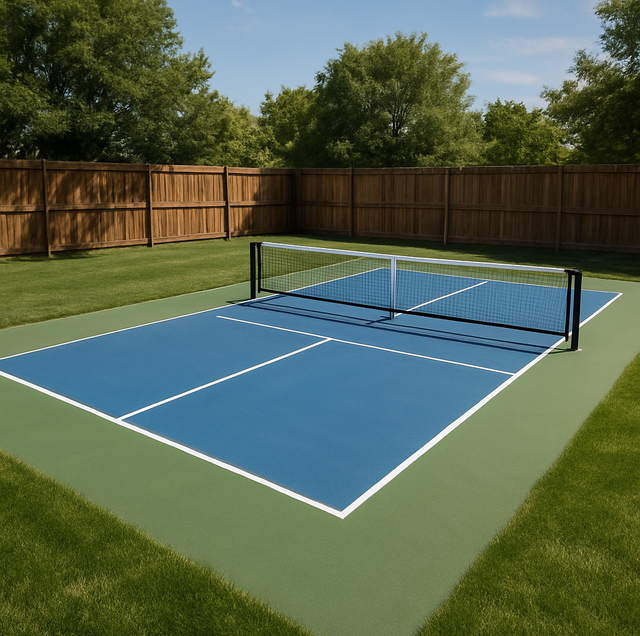
A single-sport court is built around one game and nothing else. The slab is sized to that game's dimensions, the lines serve only that game, and the equipment is fixed to it. A pickleball court has a 20-by-44-foot playing area for the lines, though the full pad needs run-off room around it, closer to 30 by 60 feet, so players are not stopping at the fence. A half-court setup is sized to its key and three-point arc with a single hoop. A bocce court is a long, narrow lane with framed sides and a specific base underneath.
The appeal is clarity. There is one set of lines to read, one purpose, one look. Players never squint at the surface trying to find the boundary that belongs to their game, because every line on the pad is theirs. The court photographs clean and feels purpose-built, because it is.
The cost of that clarity is obvious the first time someone in the household wants to play something else. The pad does one thing. If the family's interests shift, or a visiting cousin wants to shoot hoops on a pickleball court, the surface has no answer.
What A Multi-Sport Court Actually Is
A multi-sport court, sometimes called a multi-use court, takes that same rectangle and stripes it for several games at once. One pad might carry pickleball lines, a basketball key, and a futsal box, with the boundaries for each game painted in different colors so they stay distinct. The net is portable or set into ground sleeves, so it comes out for basketball and drops back in for pickleball. The hoop adjusts in height, so younger and older players can share it.
The result is that a modest footprint does the work of three or four separate courts. That is the entire point of the format in a small yard: you are not choosing which game to build for; you are building for the games the family rotates through over the course of a week.
The tradeoffs are honest ones. The surface carries more lines, so it looks busier, and readability depends on smart color contrast rather than empty space. And in a very tight yard, fitting several games can mean one of them lands slightly under regulation, a shorter run-off behind a baseline, or a slightly compressed key. None of that ruins backyard play, but it is worth knowing going in.
The Analogy That Makes It Click
Think of the court like a kitchen. A single-sport court is a dedicated pizza oven: it does one thing beautifully, and everyone knows exactly what it is for. A multi-sport court is a good range with a few burners and an oven: no single function is quite as specialized, but one appliance feeds the whole household through every meal of the week. In a small kitchen, most families take the range. In a small yard, the same logic usually holds, unless one game is the only reason the court exists at all.
The Factors That Actually Decide It
Yard Size and Shape
This is the biggest constraint, full stop. A long, narrow yard suits some games and fights others. A short, square pad may fit a half-court comfortably, but force compromises on a full pickleball run-off. Measure the usable area, not the whole yard, because setbacks, slopes, trees, and equipment pads all subtract from what you can pave. The shape of what is left often makes the single-versus-multi call for you before preference ever enters the picture.
Which Games the Family Plays, And How Often
List the games the household plays, then be honest about frequency. If three people play pickleball twice a week and one person shoots hoops occasionally, a court weighted toward pickleball with a shared hoop makes sense. If everyone plays something different, multi-sport earns its keep. A single-sport court only wins here when one game so dominates that the others barely register.
Surface Type
The playing surface changes how each game feels and how the pad holds up. A poured, acrylic-coated slab gives a consistent, true bounce and a uniform look, and it is the common choice for a permanent court. Modular tiles that snap together over a base are a lower-disruption route when you want to avoid a full pour. The surface you choose interacts with the games you want, so it belongs in the decision early, not as an afterthought.
Equipment
Multi-sport living or dying comes down to equipment. Removable nets, an adjustable-height hoop, and ground sleeves that let posts drop in and out are what turn one pad into several courts. On a single-sport court, the equipment is simpler and fixed, because it never has to change roles.
Single vs Multi-Sport Court: A Side-By-Side
| Factor | Single-Sport Court | Multi-Sport Court |
|---|---|---|
| Games | One, done well | Several on one pad |
| Lines | One clean set | Color-coded overlaid sets |
| Equipment | Fixed to the game | Removable net, adjustable hoop, sleeves |
| Size fit | Full regulation easier | May trim a game to fit |
| Best for | One dominant game | A family with mixed interests |
Keeping A Busy Court Readable
The line question is the one people worry about most, and it is a fair worry. Several games' worth of boundaries on one surface can look like a tangle if they are all painted the same shade. The fix is contrast. Each game gets its own color, chosen so it separates cleanly from the others and from the base coat, and the sets are planned together rather than added one at a time. Done well, a player's eye locks onto their game's color and the rest recedes. Done carelessly, the pad becomes a puzzle. This is why the striping plan matters as much as the pour.
Sun, Surface, And Color
Sun and heat cut both ways on the surface. Intense sun fades court color and stresses coatings over years of exposure, which is why heat-rated acrylic systems and periodic resurfacing keep a court playing true. At the same time, heat is why so much backyard play happens in the cooler evening hours, which puts a premium on strong lighting and on color choices that hold up rather than wash out under both harsh midday sun and after-dark LEDs. The point is not to fear one season. It is to build the surface and pick the colors for year-round exposure, because a court in a warm, sunny spot gets used and stressed all twelve months.
Containment In A Small Yard
The tighter the yard, the more a loose ball costs you. A missed shot or an over-hit rally that clears a fence turns into a hunt across the neighbor's lawn, and after enough of those, the court stops getting used. Containment fencing or netting around the court keeps play inside the boundary and off adjacent property. In a small yard, it is less a luxury than the thing that makes the court practical, because it is the difference between a game that flows and a game that stops every few minutes.
So Which One Fits Your Backyard
Start with the rectangle you actually have, then match it to the games your family actually plays. If one game clearly rules the household and the yard has room to lay it out properly, a single-sport court gives you a clean, dedicated space with none of the compromises. If several people want several games and space is tight, a multi-sport court is almost always the better use of a small footprint, and thoughtful line colors plus swappable equipment keep it from feeling cluttered or cramped. Either way, the yard's real dimensions and the family's real habits should drive the choice, not a picture of a court that was built for a different backyard than yours.
Frequently Asked Questions
Even a modest yard can hold a multi-sport pad if the sports are chosen to fit the space rather than forced into it. A pickleball court needs about 20 by 44 feet for the lines, with runoff space around it that pushes the ideal pad closer to 30 by 60. A half-court basketball setup can share that same footprint, so the two overlap instead of stacking. Because of that overlap, there is no single fixed minimum square footage; the yard's usable dimensions, after setbacks and obstructions, are what decide which games fit.
The lines for each game are painted in contrasting, color-coded sets so players can pick out the ones for their game and ignore the rest. Order matters as much as color: the lines for the most-played game go on last, painted on top of the others, so they read clearest and are not broken up where sets cross. A striping pro plans those colors and that layering together, so even a court carrying three or four games reads clearly rather than turning into a tangle.
Sometimes, in a tight yard. Fitting several games onto one pad can mean a slightly smaller basketball key or a shorter run-off behind a baseline, because the space has to be shared rather than dedicated. The plan balances how close to regulation each sport can get against the actual space available, so the compromise lands on the game that needs it least rather than being spread evenly across all of them.
Removable or portable nets, an adjustable-height basketball hoop, and sleeves set into the surface let one pad switch from pickleball to basketball to another game in minutes. The ground sleeves are set in concrete during the pour, then capped flush with the surface when empty, so nothing sticks up to trip a player, and a net or standard drops straight in when needed. The flexibility comes as much from the equipment as from the painted lines, which is why it is planned into the pour rather than added later.
A poured acrylic-coated slab gives a true, consistent bounce and a uniform look, which is why it is the common pick for a permanent court. Modular snap-together tiles are a lower-disruption option that drains water off the surface and cushions the foot a little, and they can go down over an existing base with less demolition. The right choice depends on the games you play, the base already in the yard, and how permanent you want the installation to be.
Usually yes. Containment fencing or netting keeps balls in a small yard and off the neighbors' property, which matters even more when the boundary runs close to the fence line. The height and placement are sized to the games, since a high basketball rebound and a low pickleball dink travel differently, and getting that right is often the difference between a court that flows and one that sends someone chasing a ball every few minutes.
Book a free design consultation — get a court laid out for the yard and games you actually have. CourtMaster Sports, Inc. serves the Coachella Valley and Las Vegas. Call (760) 548-3535.
