
How to Choose Court Colors That Resist UV Fading for Years
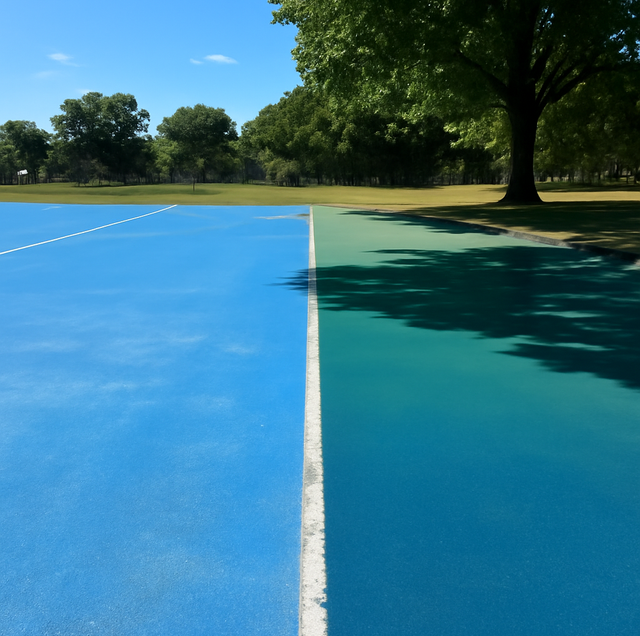
A court that looked deep green and crisp blue on installation day can drift toward a chalky, washed-out version of itself after a few seasons in the sun. That change is not dirt, and it is not wear from play. It is the pigment in the acrylic coating that is slowly breaking down under ultraviolet light. Understanding why that happens is the difference between picking a color you love for one season and picking one that still looks close to right many years later.
The good news is that fade resistance is mostly decided before the first coat goes down, at the moment you choose the color and the coating system. Some pigments shrug off UV for a long time. Others start surrendering their brightness almost immediately. Once you know which is which, the color decision stops being a gamble.
Quick Answer: Court colors fade because ultraviolet light breaks down the pigment in the acrylic coating over the years of exposure. Colors built on inorganic mineral pigments, like the iron oxides and stable blues and greens used in classic court finishes, resist UV far better than bright organic pigments. To keep color the longest, choose lightfast pigments, use a quality acrylic system, and plan for periodic recoating.
Why Acrylic Court Coatings Fade in the First Place
An acrylic court surface is a stack of thin coats: a resurfacer and filler layer that smooths the base, then pigmented color coats, then the line paint on top. The color you see is pigment particles suspended in an acrylic binder. Ultraviolet radiation from sunlight carries enough energy to break the chemical bonds that give a pigment its color. Over months and years, that steady bombardment degrades the pigment molecule by molecule, and the color reads lighter, grayer, and less saturated.
Think of it like a beach towel left folded over a railing all summer. The part exposed to the sun goes pale while the folded-under section keeps its original color. The fabric is fine, but the dye simply gave up under UV. A court works the same way, except the whole playing surface is the exposed part of the towel, all day, with no shaded fold.
Two things decide how fast that happens. The first is how much UV the surface takes, which is a function of sun intensity and hours of exposure. The second, and the one you actually control, is how resistant the pigment is to that UV in the first place. Sun intensity is a year-round pressure in a high-UV, high-sun climate: the summer months bring the harshest, most direct radiation, but clear winter skies and thin, clear air keep UV levels meaningful even in the cooler season. A court never really gets a long rest from the sun, which is exactly why pigment choice carries so much weight.
Pigment Type Is the Real Driver of Fade Resistance
Pigments fall into two broad families, and the split between them explains most of what you see on faded courts.
Inorganic pigments, also called mineral pigments, get their color from stable metal-oxide compounds. Iron oxides produce the earthy reds, tans, and browns; other mineral compounds produce durable greens and blues. Because the color comes from a rugged compound rather than a fragile molecule, these pigments are highly UV-resistant. They hold their tone for a long time.
Organic pigments are carbon-based colorants that behave more like dyes. They can produce brilliant, high-chroma colors that inorganic pigments simply cannot match, which is why the most eye-popping shades tend to be organic. The trade-off is that their color-bearing structure is more vulnerable to UV radiation, so they lose brightness faster. A vivid court that dazzles at install can be the same court that looks tired soonest.
This is why the traditional court palette, the classic greens and blues, endures. Those colors were settled on partly because stable mineral pigments were available in exactly those hues. They are not just tradition for tradition's sake; they are the colors that happen to sit on the durable side of the pigment divide.
Color Choice: Which Hues Hold and Which Surrender
Once you understand the pigment families, color selection becomes a practical question of which hue is available in a stable form.
Classic tournament greens and the standard court blues are typically formulated from inorganic pigments and hold their color well. Earth tones drawn from iron oxides are similarly durable. On the other end, the most saturated, candy-bright shades, especially vivid reds and purples, often rely on organic pigments to achieve that intensity, and those are the colors most likely to look noticeably faded first.
None of this means bright colors are off the table. It means a bright color is a choice with a known cost: more frequent recoating to keep it looking sharp. If a bold custom color matters to the design, the smart move is to go in expecting to refresh it sooner rather than being surprised when it fades.
The Coating System Matters as Much as the Color
Two courts can be painted the same shade of green and age very differently, because pigment is only part of the formula. A quality acrylic system uses well-dispersed, UV-stable pigment at proper loading in a durable binder, applied at the right film thickness over a sound base. A cut-rate coating may thin the pigment, use cheaper colorants, or skimp on film build, and it will look washed out far sooner, even in the same sun.
Film thickness matters because a thicker, properly built color coat gives UV more pigment to work through before the surface reads faded. A thin coat has less color in reserve. This is why the coating system deserves as much scrutiny as the color swatch. The best pigment in the world underperforms in a poorly built system, and a solid system stretches the life of even a moderately stable color.
Heat and Darkness: A Comfort Question, Not a Fade Question
There is a common mix-up worth clearing up. Darker court colors absorb more solar heat and get hotter underfoot, which is a real comfort consideration for players in hot conditions. But heat absorption and fade resistance are separate issues. A dark green built on stable mineral pigment can resist fading well while still running hot, and a light color built on an unstable organic pigment can fade quickly while staying cooler to the touch.
So when you weigh a darker surface, weigh it on comfort grounds: how hot the court will get during peak play. Do not assume dark automatically means fast fading, because the pigment behind the color, not the darkness of the shade, decides that.
Maintenance: Fade Is Slowed, Then Renewed
Even the most lightfast pigment in the finest system will eventually fade, because UV never stops. The realistic goal is not permanence but a long, slow decline followed by renewal. A resurfacing recoat lays fresh, fully saturated pigment back over the surface and resets the clock. Planning for that periodic recoat is part of owning a court, just as repainting is part of owning a house.
Building the plan around the color you chose makes it predictable. A stable green or blue in a quality system stretches the interval between recoats. A bright organic color shortens it. Either way, knowing the recoat is coming lets you budget the timing instead of reacting to a surface that suddenly looks worn out.
Putting It Together When You Choose
The decision comes down to a short sequence. Start with pigment stability: favor colors available in inorganic, lightfast form if long color life is the priority. Then choose a quality acrylic system with proper pigment loading and film build, because the system multiplies or undercuts whatever the pigment can do. Treat any bright organic color as a deliberate tradeoff, vivid but shorter-lived, and plan its recoat interval accordingly. Judge darker shades on heat comfort, not on fade fear. And accept from the outset that a recoat down the road is normal, then design the timeline around the palette you picked.
Do that, and the court that looks right on opening day still looks close to right many seasons later, holding its color against a sun that never fully lets up.
Frequently Asked Questions
The fastest to fade are the bright, highly saturated colors made with organic pigments, which is why some vivid reds and purples lose their punch soonest. Pastel and tinted versions behave differently, though, because a tint is a pigment mixed with white: a tinted red fades toward its pale base rather than disappearing, so it looks washed out rather than gone, while a full-strength organic color shifts far more obviously as it degrades. Court greens and blues built on inorganic iron oxide and stable mineral pigments hold their color longest, because the colorant is a rugged compound rather than a light-sensitive dye.
Lightfastness is a pigment's rated resistance to fading under UV exposure, often expressed on a standardized scale. Inorganic mineral pigments score high on that scale because their color comes from a stable metal-oxide compound, while a dye-like organic colorant sits lower because sunlight breaks its structure down more readily.
Darker colors do not necessarily fade faster, since fading depends on the pigment's stability rather than the shade's darkness. A dark color built on a stable pigment can hold up well. Darker surfaces do run hotter, though: a dark court surface in full sun can measure roughly 15 to 20-plus degrees hotter than a light one, which is the real comfort tradeoff. That heat question is entirely separate from how fast the color itself fades, and the two should be weighed on their own terms.
A fresh color coat or a UV-stabilized topcoat renews the surface and adds a sacrificial layer that takes the brunt of the sun. Periodic recoating restores color and protects the pigmented layers beneath, so the surface you play on ages while the deeper coats stay fresher for longer.
It varies with the pigment used and how much direct sun the court gets, so there is no single number. As a practical interval, a quality acrylic color coat is typically recoated every four to eight years, and choosing a lightfast palette pushes toward the longer end of that window. A cheap system built with weak colorants shows a washed-out look well before that, sometimes within a couple of seasons. That gap is why the coating system matters as much as the color you select.
Yes, the line paint is its own coating with its own pigment, and it can chalk or turn slightly yellow over time rather than simply fading gray. Lines are usually refreshed during resurfacing, so the line paint and the color coat are maintained on the same visit, and the entire surface is renewed together.
Book a color consultation for your court — get a palette built to hold its color under desert sun. CourtMaster Sports, Inc. serves the Coachella Valley and Las Vegas. Call (760) 548-3535.
