
Tennis Court Size: How Much Room You Actually Need
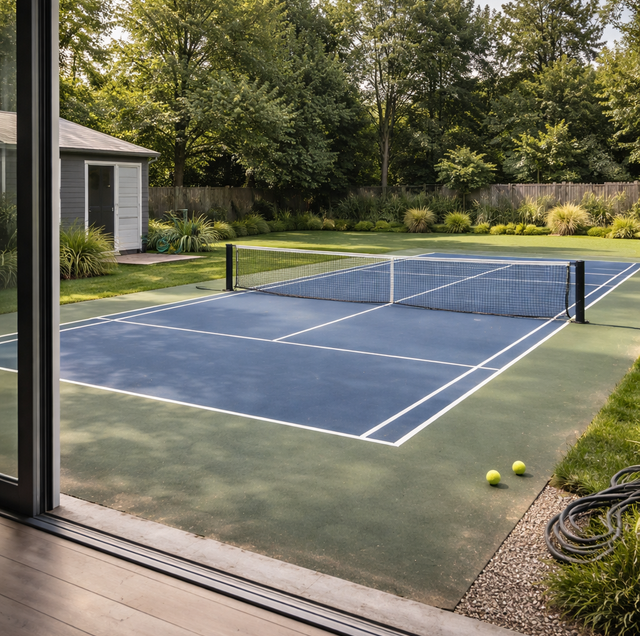
Quick Answer: The playing lines of a full-size court measure about 78 feet long by 27 feet wide for singles, widening to 36 feet for doubles. But the space you actually need is larger. A comfortable total footprint commonly runs around 120 feet by 60 feet once you add run-back behind each baseline and clearance beside each sideline. Plan around the total, not the lines.
Almost everyone who measures their backyard for a tennis court measures the wrong thing first. They pace out the painted rectangle, the part where the ball bounces, and stop there. The painted rectangle is the smaller number. The number that decides whether a court fits, plays well, and stays safe is the space around it, the room a player uses when a deep shot pushes them well behind the baseline or a wide ball drags them past the sideline.
The Two Numbers That Get Confused
There are two measurements at play, and mixing them up is the single most common planning mistake.
The first is the court proper, the area inside the painted lines. This is fixed by the rules of the game and does not change from one property to the next. The second is the total playing area, which includes the safety space beyond the lines. That second number is where properties differ, where budgets get set, and where a project either works or gets squeezed into something that plays poorly.
A court sized only to its lines is like a two-car garage built to the exact width of two parked cars, with no room to open the doors. It technically holds the cars. It fails at the thing a garage is for. A tennis court with no run-off holds the lines but fails at the thing a court is for, which is chasing the ball safely at speed.
Court Playing Dimensions: Singles Versus Doubles
The painted court is the same length for every level of play. It measures 78 feet from baseline to baseline. What changes is the width.
Singles: A singles court is 27 feet wide. The singles sidelines are the inner set of lines, and in singles play the alleys on each side are out of bounds.
Doubles: A doubles court is 36 feet wide. The extra width comes from the doubles alleys, the roughly 4.5-foot lanes added to each side of the singles court. Most courts are built and marked for doubles, since a doubles court can host singles simply by using the inner lines, but a singles-only court cannot host doubles.
The net stretches across the middle at the court's width. At the center, it commonly sits about 3 feet high, rising to roughly 3.5 feet where it meets the posts at the sides. That center dip is deliberate, and it is part of why the court reads as symmetrical from the baseline.
These figures are the widely used standards for a regulation court. Treat them as the starting rectangle, then build outward.
Why the Run-Off Space Matters
Run-off is the clear, playable surface beyond the lines. It exists because tennis is not played standing still on the line. A player returning a deep serve is often several feet behind the baseline when they make contact, then keeps moving as they recover. A wide ball pulls them past the sideline mid-stride.
Without room to run out those steps, players brake hard, collide with fencing, or pull up short and miss balls they should reach. The clearance is not decoration. It is the difference between a court that plays like a real court and one where every deep rally ends at a fence.
Behind the baseline: The run-back is the deepest clearance and the one people cut first when space is tight, which is a mistake. Back-court movement is constant, so this is where generous space pays off most. A commonly cited comfortable figure is about 21 feet of clear space behind each baseline for recreational and club-style play, though private courts sometimes work with less.
Beside the sideline: Side clearance protects wide play and, on a doubles court, gives room to cover the alley. A commonly used figure is roughly 12 feet of clearance outside each sideline. Less is workable on a private court where the level of play is gentler, but every foot trimmed narrows the margin on wide shots.
The Total Footprint
Add the court proper to the run-off on all four sides, and you get the number that actually governs the project.
A full doubles court with comfortable clearance commonly lands around 120 feet long by 60 feet wide as a total footprint. That is the figure to hold against your property, not the 78-by-36 of the lines. The gap between the two numbers, more than 40 feet of extra length and over 20 feet of extra width, is exactly the space most first-time planners forget to account for.
Because the length matters more than the width for comfortable play, a lot that is long and narrow usually serves a court better than one that is short and wide. Two properties with the same square footage can give very different results depending on their shape.
Orientation: Point It North-South
How the court is aimed matters as much as how big it is. The standard is to run the long axis roughly north to south so the sun tracks across the court's width rather than straight down its length.
Aimed the wrong way, a player at one baseline stares into low morning or late-day sun during a serve or overhead, a real safety and playability problem when the ball is coming down fast. This holds in any climate: winter sun sits lower and can be harsher in the eyes even when the air is cold, and summer's long daylight stretches the hours when a badly aimed court is unplayable. North-south orientation is the evergreen fix that keeps the low sun out of the striking player's eyes across the seasons.
Site realities sometimes force a compromise on exact orientation. When they do, a small rotation is easier to live with than a full east-west layout, and lighting can extend usable hours into the evening when direct sun is no longer a factor.
Fencing, Setbacks, and the Edge of the Property
Fencing usually sits at or just outside the total playing area, so it belongs in the footprint math from the start, not as an afterthought bolted on once the slab is poured. Perimeter fencing keeps balls contained and defines the court edge, and it needs to stand clear of the run-off so a sprinting player does not meet it too soon.
Property-line setbacks are a separate constraint set by the local jurisdiction, not by tennis. Every municipality has its own required distance between a structure or hardscape and the property line, and those rules vary widely from one town to the next. Confirm the local setback before you fix the court's position, because the setback can quietly shrink the buildable area more than the court dimensions themselves do. Your builder handles this verification during layout.
When the Yard Is Smaller Than the Ideal
Not every property has 120 by 60 feet to spare, and a court can still work below that. The trade is understood up front rather than discovered later.
The most common adjustment is reduced clearance, trimming the run-back and side space below the comfortable figures. This is very often done on private residential courts, where play is more relaxed than club competition, and the deep, sprinting rallies are rarer. A reduced-clearance court is a real, enjoyable court. It simply asks players to accept a tighter margin behind the baseline.
Beyond that, dedicated smaller formats exist for truly tight sites, and multi-use surfaces can layer tennis lines with other court sports so one pad does more than one job. A site visit is the honest way to find the largest, best-playing court a given yard supports, since the answer depends on the lot's shape, slope, and setbacks, not just its total area.
Whatever the size, the foundation decides the lifespan. A lasting court starts with a properly engineered base and real drainage so water moves off and out instead of pooling under the surface, since trapped water is what undermines a slab and cracks a coating over time. Professional layout and base work are what separate a court that plays true for years from one that needs rework in a few seasons. This is the part to get right before any lines are ever painted.
Frequently Asked Questions
For a doubles court, the net posts stand about 3 feet outside the doubles sidelines, so the net is fully supported across the wider court. On a singles-only setup, singles sticks are placed to hold the net at the correct height nearer the singles lines. The posts always sit outside the play area, never on a line.
A total footprint of roughly 120 by 60 feet works out to about 7,200 square feet, versus roughly 2,800 square feet for the doubles lines alone. That difference is why square-footage estimates based only on the painted court run badly short of the real graded and surfaced area a builder has to prepare.
Yes, and side-by-side courts share the between-court space rather than each needing full clearance, so two courts take less than double the width of one. A common shared alley between adjacent courts runs on the order of 12 feet, though a taller dividing fence or windscreen between them changes how tight that gap can be.
It is not dead flat. A court is built with a slight, consistent slope, commonly around 1 percent in a single plane, so water sheets off in one direction instead of ponding. The slope is gentle enough that play is unaffected but steep enough to clear rain, which is why an eyeballed backyard pad without engineered fall tends to hold puddles.
They need more in one dimension most people forget: overhead height. An indoor court needs substantial clear ceiling height above the net and service areas so lobs and high serves are not clipped, typically far higher than the fence height an outdoor court uses. The floor footprint is similar, but the vertical requirement is what rules many existing buildings out.
Layout itself is quick, but the sequence that follows- excavation, base construction, curing, surfacing, and line painting- is measured in weeks, not days, because several stages have to cure before the next can start. Rushing the cure between stages is a leading cause of early cracking, so the calendar is set by the material, not by how fast a crew can work.
Book a free on-site court assessment — get the exact footprint your yard supports before you plan anything else. CourtMaster Sports, Inc. serves the Coachella Valley and Las Vegas. Call (760) 548-3535.
