
How Much Space Does a Pickleball Court Actually Need?
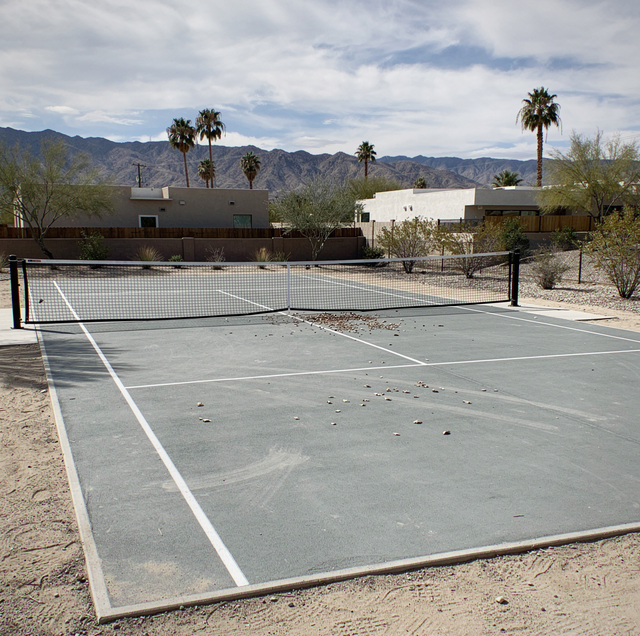
Stand at the edge of a finished pickleball court, and the first surprise is usually how compact it looks. A regulation court measures 20 feet wide by 44 feet long for both singles and doubles play, the same footprint either way, with a 7-foot non-volley zone (the "kitchen") running the width of the court on each side of the net. That's roughly the size of a doubles badminton court, and it's smaller than most people expect once they've watched a match on television, where camera angles and open space around the lines make everything look bigger than it is.
That 20-by-44 number is the part everyone quotes when they ask about space, and it's also the part that causes the most confusion. It describes the playing surface: the lines, the net, the kitchen. It says nothing about how much land you actually need to build one, because a court with no room around it isn't a court anyone can play on safely.
The Official Court Is Smaller Than Most People Picture
The gap between "court size" and "space needed" comes down to run-off, sometimes called buffer space: the paved or clear area surrounding the lines where players can chase a ball, recover from a lunge, or step back from a smash without hitting a fence, a wall, or another court.
Recommended minimums call for at least 30 feet of width and 60 feet of length for a single court, which adds roughly 5 feet of side buffer and 8 feet of end buffer beyond the lines on each side. That extra space isn't decorative. It's where a player's momentum actually carries them after a shot, and it's the difference between a court that plays well and one that feels like playing inside a phone booth.
Where space allows, a more comfortable footprint is closer to 34 by 64 feet, and dedicated club or tournament courts often approach 36 by 66 or larger. The wider the buffer, the more a court can absorb full-speed play near the baseline and sideline without players constantly checking how close they are to a fence.
Why the Court Number Isn't the Space Number
It's easy to treat buffer space as a nice-to-have rather than a real design factor, but the underlying mechanism is simple to trace. Pickleball involves quick direction changes, low volleys near the kitchen line, and the occasional full sprint to chase a ball that clears the baseline. A player moving at speed needs room to decelerate before they reach anything solid.
A court with a tight or undersized buffer changes how people actually play on it. Players start pulling up short on shots they'd otherwise chase, hugging the center of the court instead of using the full width, and avoiding the corners where a fence or wall sits close behind the line. That's a play-quality problem as much as a safety one: the court technically meets the 20-by-44 dimension, but the way people use it shrinks to fit the available run-off.
The safety side is more direct. A fall near an undersized buffer means landing on or near a fence post, a retaining wall, or a piece of patio furniture rather than on open pavement. Uneven or narrow buffer zones are also where most collision-with-fixed-object incidents on backyard and community courts actually happen, not on the court surface itself.
What Buffer Space Actually Does for Safety and Play Quality
A homeowner working with a backyard has to reconcile the ideal footprint against whatever rectangle of usable, level ground actually exists on the property. In practice, a workable residential court, including a buffer, generally needs somewhere in the neighborhood of 30 by 60 feet at the tight end and up to about 34 by 64 feet if the lot allows. Anything smaller than the 30-by-60 minimum usually means giving up buffer space on at least one side, which shows up later as a court that feels cramped during actual play rather than during the initial walk-through of an empty yard.
Backyard installs also have to account for what's already occupying the lot: pool equipment, a shed, mature trees, property line setbacks, and HOA rules that may dictate how close a hard surface can sit to a fence or a neighboring structure. It's common for the available flat space on a residential lot to be close to the minimum footprint but not quite match its proportions, which is where a tennis-to-pickleball conversion becomes relevant. A single tennis court, at 60 by 120 feet, has enough room inside its lines and buffer to stripe multiple full pickleball courts, and re-striping (with or without a fence reconfiguration) is often a more efficient use of an existing hard surface than starting from scratch on open lawn.
Fitting a Single Court on a Residential Lot
A single backyard court and a multi-court community installation aren't the same design problem scaled up. Once you move beyond one court, the spacing between adjacent courts becomes a separate variable, distinct from the buffer around the outer edges of the installation.
Courts placed side by side generally need a shared buffer of at least 10 to 12 feet between the sidelines of neighboring courts, enough for two players on adjacent courts to both have room to chase a wide ball without colliding mid-play. Courts placed end to end need a similar allowance behind each baseline. Multiply that across four, six, or eight courts and the total site footprint grows well beyond simply adding up individual court rectangles, since every shared edge needs its own buffer allowance.
Multi-court sites also introduce fencing decisions a single backyard court usually skips: a shared perimeter fence versus separate fences per court, and where gates go so players can move between courts without cutting across an active game. None of that changes the 20-by-44 playing dimension, but it changes almost everything else about how much land the project consumes.
What Changes When You're Planning Multiple Courts
Court orientation affects playability in a way that has nothing to do with total space but everything to do with how comfortable that space is to use. The long axis of a court is generally set running north to south, which keeps the sun low on the sideline rather than directly in a player's eyes at the net during the parts of the day when courts see the heaviest use.
An east-west orientation puts the sun squarely down the length of the court during the early morning and late afternoon, exactly when a lot of recreational play happens. A serve that's routine under midday sun becomes a real visibility problem at a low sun angle, and orientation is one of the only siting elements that can't be corrected after construction without starting over.
Orientation: Which Way Should the Court Face
Space calculations tend to focus on the flat, finished dimension, but what's underneath and around that footprint matters just as much. A court needs to shed water, not hold it, so the pad requires a slight, consistent slope, typically a small percentage grade across the surface, engineered so rain and irrigation runoff drain to one side or corner rather than pooling in the kitchen or along the baseline.
Getting that grade right depends on the surrounding ground, which is part of why siting a court isn't just about finding a flat-looking rectangle. Low spots, existing drainage patterns from downspouts or neighboring hardscape, and sub-base compaction all affect whether a properly built slab drains as designed once it's in the ground. Skipping proper grading and sub-base preparation to save space or fit an awkward lot is one of the more common reasons a court develops standing water or uneven settling within the first few seasons.
Drainage and the Ground Beneath the Footprint
The sound of a paddle striking a hard pickleball is sharper and carries differently than a tennis ball off strings, and that acoustic profile is a real siting consideration, not just a space one. Courts placed close to a home's windows, a neighboring property line, or a shared fence tend to generate more noise complaints than courts set back with distance, trees, or a solid fence line acting as a partial sound break between the court and whatever's nearby.
There's no universal number that guarantees no complaints, since sound travel depends on surrounding structures and how the court is oriented relative to nearby windows, but distance and a solid perimeter fence (rather than open chain-link) both measurably cut how far that paddle pop carries. That's worth weighing against the instinct to tuck a court into the tightest available corner of a lot: the corner that fits the footprint on paper isn't always the one that keeps the peace with whoever's on the other side of the fence.
Distance From Structures, Fences, and Neighbors
There's a real tension in every court-siting decision. More buffer space plays better and reads as safer, but it also requires more usable land, more grading, and often a longer distance from existing structures than a lot may offer. A tighter footprint fits more properties and more budgets, but it changes how the court actually gets used once the excitement of a new install wears off and the buffer strip along the baseline turns out to be a foot narrower than it should have been.
Getting the sizing conversation settled before any concrete is poured, not after, is what keeps a court from becoming a compromise everyone quietly works around every time they play.
Weighing the Tradeoffs Before Committing to a Footprint
Frequently Asked Questions
Yes, and it's common on properties converting part of an existing tennis court, but the shared fence needs posts and footings positioned so they don't sit inside either sport's buffer zone; a fence line built for tennis spacing sometimes needs relocated posts before it works safely for the tighter pickleball layout next to it.
A permanent shade structure or pergola generally needs its support posts kept outside the same buffer zone as a fence, and the overhead clearance matters too, since a lob or a high defensive shot can reach 25 to 30 feet up before coming back down, higher than most standard patio covers.
A reduced buffer changes how the court plays regardless of intended use, since even casual players chase balls and lose their footing near the lines; a narrower buffer is a workable compromise on a tight lot, but it should be a deliberate tradeoff rather than an assumption that casual play needs less room.
A service or cart gate wide enough for equipment access, typically at least 8 to 10 feet, needs its own clearance beyond the court's buffer zone, which can add several feet to the overall site footprint beyond what the court and its running room alone would require.
Yes, adjoining courts commonly share a combined buffer strip rather than each court maintaining its own full-width buffer, which is how multi-court sites keep the total footprint from growing as quickly as simply multiplying one court's space by the number of courts.
Wind mainly affects ball flight and windscreen decisions rather than the footprint itself, but a court sited in a consistent wind corridor between buildings often needs a taller or more solid windscreen along the windward fence line, which is a fencing decision layered on top of, not instead of, the space and orientation planning already covering the court.
Getting the Space Right Before the Ground Gets Touched
The lines on a pickleball court never change. What changes, project to project, is everything around those lines: the buffer that makes the game playable at speed, the orientation that keeps the sun out of a returner's eyes, and the drainage and distance that keep a fast-paced game from turning into a maintenance problem or a dispute with whoever lives closest to the fence.
Schedule a site evaluation — get a professional read on whether your lot has the room, grade, and orientation for a court that plays the way it should. CourtMaster Sports, Inc. serves the Coachella Valley and Las Vegas. Call (760) 548-3535.
